


Sentiment remains divided, with 22 of the 47 analysts covering the stock recommending a “sell”, 15 suggesting “hold”, and only 10 maintaining a “buy” rating.
IndusInd Bank’ is under the spotlight again, and not for the best reasons. As insider trading allegations, governance concerns, and leadership uncertainty swirl around the private lender, the question now is whether the worst is truly behind it—or if there’s more to come.
The stock has already taken a hit, falling nearly 47% from 52-week high of ₹1,550 to ₹820 on May 29. It’s down over 15% for the year so far.
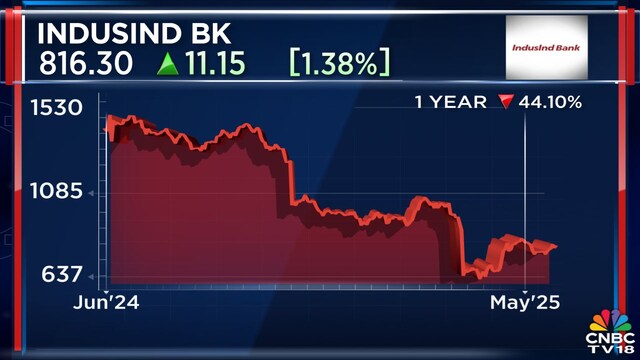
But some market watchers believe it’s already priced in the bad news.
“It is trading at extremely attractive valuations, price to book, price to earnings,” said Dipan Mehta, Director at Elixir Equities, who feels that much of the damage may already be reflected in the stock. “The time to sell is gone, so you just hang in there.”
Rikin Shah, Senior Vice President at IIFL Capital, pointed out that the stock has not reacted much despite several fraud-related disclosures over the past few months and SEBI’s interim order against the former MD and CEO, suggesting most of the damage may already be priced in.
Also Read | SEBI order traces 15-month delay in IndusInd Bank’s derivatives disclosure: Full Timeline of Events
Still, it’s not a clean slate just yet. SEBI’s interim order alleging insider trading by five former senior officials, including ex-CEO Sumant Kathpalia, has raised new red flags. Amit Tandon, Managing Director at IiAS, warned that these charges suggest deeper, structural lapses.
“What does it mean for the board? Were they shielding the management or were they taken by surprise?” he asked. “If there is action against the board, you can expect more tumultuous times.”
More troubling is the suggestion that governance gaps run deeper than initially assumed. SEBI has pointed to a board note from 2023 leading to KPMG’s appointment for a review, contradicting earlier statements that the board became aware of issues only in March 2024.
Tandon doesn’t expect this to blow over easily. “If a financial institution loses trust, it takes a long, long time to build it back—if it can build it back.”
Investors hoping for a quick turnaround may be disappointed. The path ahead could involve a complete leadership overhaul, tighter compliance, and internal restructuring. “One of the first ways to build trust is to bring in a completely new leadership team, revamp the compliance function, revamp risk management,” Tandon added.
For now, the market seems split. Some see the crisis as an opportunity to buy at distressed valuations. Others, like Mehta, remain cautious. “Just playing for recovery is not a great strategy,” he said, pointing out that turnaround timelines are hard to predict.
As the bank prepares to appoint a new CEO, investors are watching closely. Whether that triggers a new phase of stability or deeper churn remains to be seen.
Also Read | IndusInd Bank shares in focus after SEBI insider trading order on top management officials
Also Read | Sumant Kathpalia resigns as MD and CEO of IndusInd Bank
For the full interview, watch the accompanying video
Catch all the latest updates from the stock market here


