


- Risk appetite is driving markets, and keeping Euro downside attempts limited.
- A sharp decline in Oil prices is giving additional support to the common currency.
- EUR/USD has broken the top of a bullish flag formation and aims for 1.1630 and 1.1700.
The EUR/USD pair ticked down below 1.1600 on Tuesday’s European session but remains at levels well above Monday’s lows despite Israel’s accusations that Iran violated the ceasefire. The pair had jumped about 1.30% from the previous day’s lows after Trump announced a “complete and total ceasefire” in the Middle East conflict.
Israel accused Iran of launching missiles into their territory in violation of the ceasefire and threatened a strong response to the Islamic Republic. Tehran has denied the accusations. Risk appetite has faltered somewhat, Oil prices have trimmed some losses, but the US Dollar remains depressed.
Crude prices are dropping nearly 3% so far on Tuesday, following a nearly 13% sell-off on Monday, with the barrel of WTI returning to $63.00 from above $77.00. The decline in Oil prices gives some respite to the Eurozone, as Europe is a net Crude importer, and expensive Oil would add inflationary pressures on a weakening economy.
With geopolitical tensions easing, the Fed Chairman Jerome Powell’s testimony to Congress, due at 14:00 GMT, will attract the focus. Investors are eager to see whether the Fed chief maintains his wait-and-see stance in the face of the increasing voices calling for a rate cut among the central bank officials.
Euro PRICE Today
The table below shows the percentage change of Euro (EUR) against listed major currencies today. Euro was the strongest against the US Dollar.
| USD | EUR | GBP | JPY | CAD | AUD | NZD | CHF | |
|---|---|---|---|---|---|---|---|---|
| USD | -0.17% | -0.62% | -0.78% | -0.11% | -0.79% | -0.93% | -0.11% | |
| EUR | 0.17% | -0.49% | -0.64% | 0.06% | -0.62% | -1.21% | 0.08% | |
| GBP | 0.62% | 0.49% | -0.14% | 0.55% | -0.12% | -0.70% | 0.42% | |
| JPY | 0.78% | 0.64% | 0.14% | 0.69% | -0.04% | -0.18% | 0.56% | |
| CAD | 0.11% | -0.06% | -0.55% | -0.69% | -0.69% | -1.25% | -0.14% | |
| AUD | 0.79% | 0.62% | 0.12% | 0.04% | 0.69% | -0.58% | 0.55% | |
| NZD | 0.93% | 1.21% | 0.70% | 0.18% | 1.25% | 0.58% | 1.13% | |
| CHF | 0.11% | -0.08% | -0.42% | -0.56% | 0.14% | -0.55% | -1.13% |
The heat map shows percentage changes of major currencies against each other. The base currency is picked from the left column, while the quote currency is picked from the top row. For example, if you pick the Euro from the left column and move along the horizontal line to the US Dollar, the percentage change displayed in the box will represent EUR (base)/USD (quote).
Daily digest market movers: Risk appetite sends the US Dollar tumbling
- Markets are going through a relief rally. The announcement of the ceasefire between Israel and Iran has dissipated fears of a full-blown war in the region, triggered by the involvement of the US during the weekend. The US Dollar Index, which measures the value of the USD against the six most traded currencies, has dropped more than 1% since the ceasefire was announced, giving away most of the ground gained over the last two weeks.
- Iran launched missiles at Israel, killing four, after an attack on a US military base in Qatar, which did not cause injuries. The Iranian Foreign Minister affirmed that Tehran will only stop its attacks when Israel ceases its airstrikes. Investors, however, are celebrating the agreement as a done deal.
- On the macroeconomic front, the German IFO Business Climate Index increased to 88.4 in June from 87.5 in May, slightly above the 88.3 expected. Business expectations have also improved, to 90.7 from the previous 88.9, beating expectations of a 90.0 reading. The impact on the Euro, however, has been minimal.
- In the US, the highlight is Fed Chairman Powell’s Semiannual Monetary Policy Report to Congress, due on Tuesday and Wednesday. The central bank’s chief will be questioned about the bank’s plans to deal with a context of weakening growth and higher inflationary pressures. His comments will be observed with interest after the recent dovish calls by both Bowman and Waller.
- Investors have ramped up bets on a Fed rate cut in the coming months following recent Fedspeak. Futures markets are now pricing a 22% chance of a July cut, up from around 14% last week, while expectations of a September cut have increased to above 80% from below 70% last week, according to the CME Group’s Fed Watch Tool.
- Eurozone data released on Monday showed that business activity remained broadly steady in June. The preliminary Manufacturing and Services PMIs came in roughly at the same levels as in the previous month at 49.4 and 50.0, respectively. The Euro retreated after the data release as investors had expected slightly better results.
- In the US, the preliminary S&P Global PMIs beat expectations. The Manufacturing PMI remained steady at 52 in June, against expectations of a slowdown to 51, while the Services PMI eased to 53.1 from the previous 53.7, still better than the 52.9 reading forecasted by the analysts.
EUR/USD breaks higher and sets its focus at the 1.1630 high
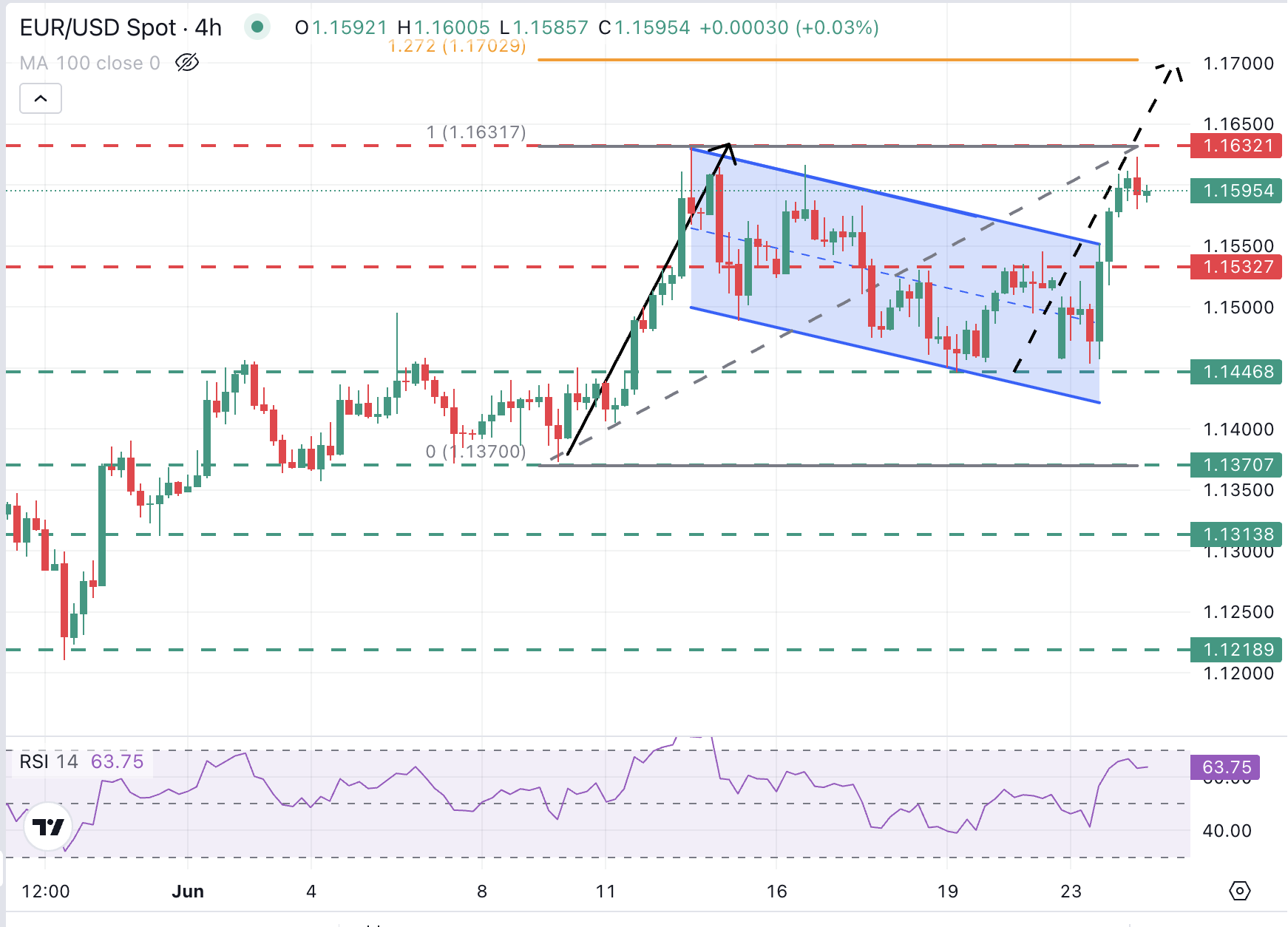
EUR/USD has broken above the top of the last few weeks’ corrective channel, boosted by a favourable market sentiment with bulls focusing on the June 12 high at 1.1630.
The breach of the trendline resistance at 1.1540 highlights a bullish flag formation, whose measured target is located at the 1.1700 area, where the 127.2% Fibonacci extension of the June 10-12 rally lies.
bring
On the downside, a bearish reaction from these levels might seek support at the reverse trendline, now around 1.1535, before rallying further. A confirmation below that level would cancel the bullish view and bring the June 19 and June 22 low at 1.1445 back to the focus.
Fed FAQs
Monetary policy in the US is shaped by the Federal Reserve (Fed). The Fed has two mandates: to achieve price stability and foster full employment. Its primary tool to achieve these goals is by adjusting interest rates.
When prices are rising too quickly and inflation is above the Fed’s 2% target, it raises interest rates, increasing borrowing costs throughout the economy. This results in a stronger US Dollar (USD) as it makes the US a more attractive place for international investors to park their money.
When inflation falls below 2% or the Unemployment Rate is too high, the Fed may lower interest rates to encourage borrowing, which weighs on the Greenback.
The Federal Reserve (Fed) holds eight policy meetings a year, where the Federal Open Market Committee (FOMC) assesses economic conditions and makes monetary policy decisions.
The FOMC is attended by twelve Fed officials – the seven members of the Board of Governors, the president of the Federal Reserve Bank of New York, and four of the remaining eleven regional Reserve Bank presidents, who serve one-year terms on a rotating basis.
In extreme situations, the Federal Reserve may resort to a policy named Quantitative Easing (QE). QE is the process by which the Fed substantially increases the flow of credit in a stuck financial system.
It is a non-standard policy measure used during crises or when inflation is extremely low. It was the Fed’s weapon of choice during the Great Financial Crisis in 2008. It involves the Fed printing more Dollars and using them to buy high grade bonds from financial institutions. QE usually weakens the US Dollar.
Quantitative tightening (QT) is the reverse process of QE, whereby the Federal Reserve stops buying bonds from financial institutions and does not reinvest the principal from the bonds it holds maturing, to purchase new bonds. It is usually positive for the value of the US Dollar.
Information on these pages contains forward-looking statements that involve risks and uncertainties. Markets and instruments profiled on this page are for informational purposes only and should not in any way come across as a recommendation to buy or sell in these assets. You should do your own thorough research before making any investment decisions. FXStreet does not in any way guarantee that this information is free from mistakes, errors, or material misstatements. It also does not guarantee that this information is of a timely nature. Investing in Open Markets involves a great deal of risk, including the loss of all or a portion of your investment, as well as emotional distress. All risks, losses and costs associated with investing, including total loss of principal, are your responsibility. The views and opinions expressed in this article are those of the authors and do not necessarily reflect the official policy or position of FXStreet nor its advertisers. The author will not be held responsible for information that is found at the end of links posted on this page.
If not otherwise explicitly mentioned in the body of the article, at the time of writing, the author has no position in any stock mentioned in this article and no business relationship with any company mentioned. The author has not received compensation for writing this article, other than from FXStreet.
FXStreet and the author do not provide personalized recommendations. The author makes no representations as to the accuracy, completeness, or suitability of this information. FXStreet and the author will not be liable for any errors, omissions or any losses, injuries or damages arising from this information and its display or use. Errors and omissions excepted.
The author and FXStreet are not registered investment advisors and nothing in this article is intended to be investment advice.


