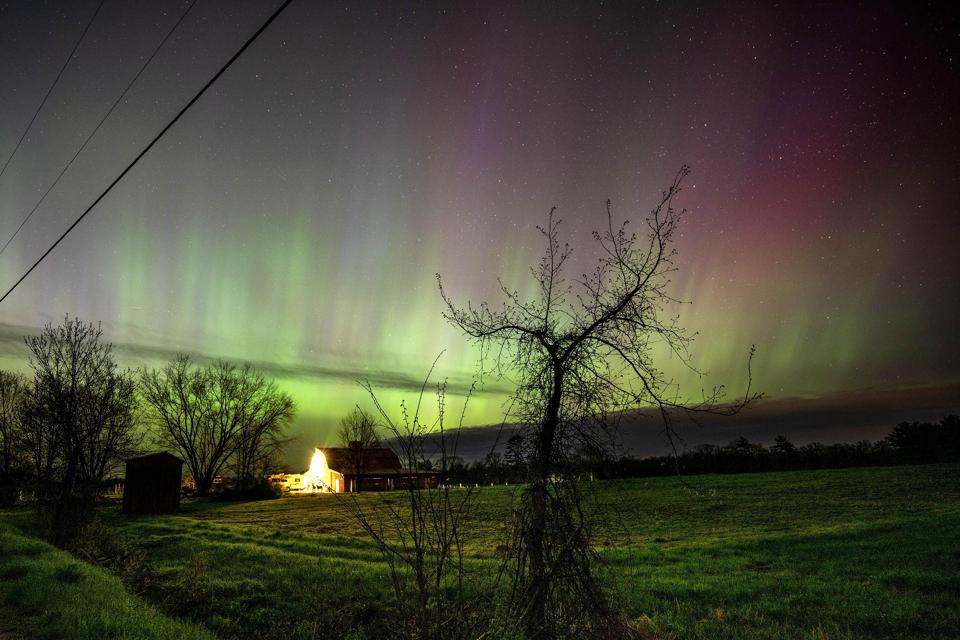
The northern lights appear in green, blue and pink paint brush strokes over a horse barn and pasture in Mercer, Maine on May 10, 2024. (Photo by Michael Seamans/Getty Images)
Getty Images
Where can I see the Northern Lights tonight? A rare forecast for a strong G3-class or severe G4-class geomagnetic storm by space weather experts could see the Northern Lights visible in northern skies from over 18 U.S. states overnight on Monday, Sept. 1 and Tuesday, Sept. 2, 2025.
Here’s everything you need to know — including what time the Northern Lights will be visible tonight, a Northern Lights map, and how to photograph the Northern Lights.
NOAA issued this update on Sunday, Aug. 31, 2025.
NOAA
Northern Lights Tonight: Forecasts And Alerts
The latest space weather forecast from the National Oceanic and Atmospheric Administration comes as the annual viewing window in the Northern Hemisphere — from September through March — kicks off.
It has a coronal mass ejection — a cloud of charged particles from the sun produced by a long-lasting solar flare — heading towards Earth, and destined to collide with its magnetosphere on Sept. 1 and Sept. 2.
“Periods of G2 (Moderate) storming are likely, with a chance for G3 (Strong) storm periods, late on Sept. 1 due to the anticipated arrival of the Aug. 30 asymmetric full halo CME,” reads a post from NOAA. A CME is a coronal mass ejection — a massive bubble of charged particles produced by a solar flare. A “full halo” CME is when it appears in images to expand in all directions. “On Sept. 2, periods of G3 (Strong) storming are likely, with a chance for G4 (Severe) storm periods, as CME influences continue,” continues NOAA. The culprit was a massive long-duration solar flare on Aug. 30.
The aurora viewline from NOAA for Monday, Sept. 1, 2025.
NOAA
Northern Lights Tonight: Where And When To See Aurora
The latest space weather models suggest that the CME may arrive — potentially sparking a G3-class geomagnetic storm — as it gets dark in North America on Sept. 1. Kp levels — an indication of how strong aurora can be — may reach around 5.67. However, they may go up a notch to 6.67 in the early hours of Sept. 2 as, potentially, a G4-class event occurs. NOAA’s forecast gives a 40% chance of a “strong extreme” storm.
According to SpaceWeather.com, auroras may be photographed in U.S. states as far south as Virginia, Missouri and Colorado. NOAA says some of the lower Midwest to Oregon.
U.S. states that may see aurora include Alaska, Washington, Oregon, Idaho, Montana, Wyoming, North Dakota, South Dakota, Nebraska, Minnesota, Iowa, Wisconsin, Illinois, Michigan, New York, New Hampshire, Vermont and Maine. U.S. states closest to the border with Canada will have the highest chance of seeing the aurora.
Note: Predicting the intensity and time of aurora displays is only possible when the solar wind hits NASA’s DSCOVR and ACE satellites a million miles from Earth — giving 20-50 minutes warning — so check NOAA’s 30-minute forecast.
How To Watch The Northern Lights On Monday
- Timing: Be outside after dark on Monday, Sept. 1. Auroras can flare unexpectedly, so check often.
- Where to Look: Face north and look for a whitish or greenish arc low in the sky — use a smartphone camera on “night mode” to capture images, which should show up green or red in photos.
- Light Pollution: The darker the sky, the better. Switch off nearby lights and let your eyes adjust for at least 15 minutes. If you can, go somewhere that looks dark on a light pollution map, but keep to the north of any cities and towns.
- Check Forecasts: Apps like Aurora Alerts, SpaceWeatherLive, Glendale and NOAA’s Aurora Dashboard provide real-time updates on storm strength.
- Be Patient: Aurora shows come in bursts — it may take hours of watching before the sky suddenly erupts in color.
People visit St Mary’s lighthouse in Whitley Bay to see the aurora borealis, commonly known as the northern lights, on May 10, 2024 in Whitley Bay, England. (Photo by Ian Forsyth/Getty Images)
Getty Images
How To Photograph The Northern Lights With A Smartphone
Smartphones are now powerful enough to record impressive images of the aurora. To maximize your chances:
- Disable the flash: It will only wash out your image.
- Use Night Mode or Pro Mode: Extend exposure times to between three and 30 seconds, depending on the brightness of the aurora.
- Shoot in RAW: If your device allows, this preserves more detail and makes editing easier.
- Use a tripod: the longer the exposure, the stiller your smartphone needs to be — though three-second exposures are usually fine handheld.
- Use the main camera lens: the ultra-wide and selfie lenses reduce quality.
- Experiment with video: switch to HD at 30 fps for smooth footage of moving aurora arcs (4K does not work as well).
Wishing you clear skies and wide eyes.