

- The recent U.N. climate conference (COP30) in Brazil resulted in the Belém Action Mechanism (BAM) to bring about a just energy transition that embraces renewable energy and expands access to power.
- But details on how the transition will be accomplished remain elusive.
- Economist Fadhel Kaboub contends that the transition should not reinforce existing inequalities in Africa and other parts of the Global South.
- Kaboub sees an opportunity in the energy transition to remedy those power imbalances, which he calls “the bargain of the century.”
Many observers see industrialization as the key to boosting clean electricity access for people living in Africa and across the Global South. They argue that building up economies with industry will bring about the investments needed to upgrade the power grid and related infrastructure to provide power to the 600 million people in Africa who currently lack any electricity.
But making sure the transition is fair means thinking about the coal workers who could lose their livelihoods and also about those who mine critical minerals essential for the renewable energy sector. The “just transition” toward renewable energy and away from fossil fuels got a boost at the November U.N. climate conference (COP30) in Brazil with the approval of the Belém Action Mechanism (BAM). The details of the BAM have yet to be sorted out, beyond a foundation of integrating existing endeavors toward low-carbon energy. But advocates applauded mentions of the rights of workers and Indigenous communities, as well as the inclusion of calls for more grants — as opposed to loans — to ease the transition.
However, delegates failed to include a plan for phasing out oil, coal and gas.
“The move to establish a just transition mechanism is positive and shows the power of civil society organising,” Friederike Strub, a climate finance campaigner at the Netherlands-based nonprofit Recourse, said in a statement. “But to make the just transition happen we need public finance backing, systemic economic reform, and a clear roadmap to end fossil fuels.”
Even amid these signs of progress, the question of how to best accomplish the transition remains.
Tunisian-American economist Fadhel Kaboub, however, cautions that a general push to bring “green industrialization” to African countries runs the risk of reinforcing, rather than addressing, the very structural inequalities that have kept so many Africans underpowered.
The emphasis in this approach has been on maintaining Africa as a place from which to extract raw materials and cheap labor, not on building up African countries’ capacity, Kaboub, an associate professor of economics at Denison University in the U.S., told Mongabay. Pursuing a similar path — even with the goal of expanding power access — could saddle Africa with more debt and stranded investments in outdated sources of dirty energy, while other countries pluck what they need from the continent to decarbonize their grids at home.

An alternative “bargain of the century,” which Kaboub sketches out in a recent paper, relies on African nations banding together to forge more equitable partnerships with countries in other parts of the world. He sees a continent brimming with promise: It holds some of the world’s largest reserves of critical minerals like cobalt, lithium and copper, which are needed to build out renewable energy infrastructure reliant on batteries, solar panels and electric vehicles. The continent has enormous potential for solar, wind and hydropower generation. And a growing population of young workers and consumers could provide the leverage necessary to demand that skill-building, capacity and technology are invested in African countries.
Fadhel Kaboub recently spoke with Mongabay’s John Cannon about the energy transition. The following interview was edited for length and clarity.
Mongabay: What is the historical context of Africa’s need for a just energy transition? Can you explain that line of thinking?
Fadhel Kaboub: The structures of colonialism that were imposed on Africa in particular can be summarized in three basic functions that the African continent was supposed to play. Number one, Africa was supposed to be the provider of cheap raw materials for the industrialized world, and we still play that role to this day. Number two, Africa was supposed to be the consumer, not the producer of knowledge and technology and industrial output, and we still play that role.
And the third major function is for Africa to be the place where you outsource obsolete technologies, such as assembly line manufacturing that is no longer needed in the industrialized world. What that does is effectively locks you permanently at the bottom of the global value chain.
That’s why we say you have to decolonize and transform those economic functions in order to achieve democracy and justice and development and sustain all of the things that we want to achieve.

Mongabay: Can industrialization in Africa play a role?
Fadhel Kaboub: There’s a lot of greenwashing around “green industrialization,” false solutions and distractions that are designed to precisely reproduce those same structures that I described. For example, you hear a lot of discussion encouraged by Global North partners for green industrialization in Africa. Why? Because Africa has the biggest renewable energy potential. It has all the critical minerals for producing all the renewable energy infrastructure.
Ultimately, it just reproduces the same economic hierarchy and greenwashes the whole thing about climate action and climate finance. But it’s purely extractive of green minerals, green resources and green energy, and it’s not delivering to the countries that need it the most in the Global South.
Mongabay: What are your views on the role that fossil fuels could — or should — play in expanding energy access?
Fadhel Kaboub: The entire fossil fuel industry is going to Africa and saying, “Look, you didn’t cause climate change. You’re a sovereign nation. You have the right to development. We’re going to help you get rich by using your sovereign resources.” They hijack the narrative of the right to development.
What I say is, it’s precisely because we have the right to development, and precisely because we have the sovereignty to decide which energy system we want to use, that we shouldn’t use the old energy system that has never delivered energy security. We should leapfrog into the new energy system. It’s as if, 100 years ago, when the world was moving into the automobile as the main mode of transportation, instead of the horse and cart, somebody comes to you and says, “You have all these horses and all these trees, all this wood. You should double down your investments in the horse-and-cart industry and let the rest of the world leapfrog into the Industrial Revolution with a new mode of transportation.” That’s precisely what the fossil fuel companies are doing, and they’re using this right-to-development narrative to recreate the classic economic entrapment that they typically do.

Mongabay: Are there ways to change the dynamics to bring about a just transition or to stoke “green” industrialization in the right ways?
Fadhel Kaboub: Here’s where I put some of the burden on Global South governments to think strategically and better negotiate the terms of these investments, because the way they’re being presented is purely extractive. Of course, there can be a spectrum of green industrialization — the good, the bad and the ugly.
The good would be to say, “OK, we’re putting all of this green infrastructure to produce electricity to feed into this green industrial zone. What you want to negotiate is real industrialization with transfer of technology. We want to manufacture and deploy the building blocks of development and prosperity, not just the assembly line manufacturing that is purely export-oriented.”
Part of the deployment is to provide access to clean energy to the 600 million people on the African continent today who have no access to electricity, dedicating some of the green industrial zone capacity to manufacture and deploy the clean cooking infrastructure for the billion people on the continent, mostly women and children, who are inhaling toxic fumes every day. This is a crosscutting issue, because it’s development, the climate, deforestation, gender. It’s everything, but it’s also an industrialization opportunity.
So how do you carve out the space within these green industrial zones to negotiate for a win-win type of scenario? Yes, some of it will help Europe. But some of it has to be of real benefit and transformation on the continent, especially in the issue of transfer of technology. This is where I don’t expect Europe to come to Namibia and say, “Here’s how you industrialize and become our competitor in 20 years.” It’s not going to happen. It has to be countries in Africa. You’ll have better leverage doing this as blocs of countries. Bilaterally, Namibia can’t get much out of the EU. But as blocs of countries, you can leverage your collective economic and geopolitical weight to say, “Let’s create a win-win scenario.”

Mongabay: You co-authored a 2023 report about the disparities in the lack of energy access contrasted with the energy potential of the African continent. Can you explain that tension?
Fadhel Kaboub: We talk about the structural deficiencies that we have economically on the continent, and one major one is energy deficits. And that is true, even for the biggest oil exporter on the continent. When we wrote the report at the time, Nigeria [consistently one of the world’s top 20 oil producers, ranking ahead of Qatar and Venezuela] imported 100% of its gasoline from international markets. The key here is that in the old-energy, fossil fuel system that we’re trying to exit, we’ve always been denied access to the technology to look for oil, to drill for oil and to refine oil.
The [2021] International Renewable Energy Agency report on Africa said, by 2040, Africa can produce 1,000 times its anticipated energy needs from renewables with existing technologies and completely replace all of the continent’s fossil fuel exports. It’s massive potential. And yet we’re still denied access to the manufacturing technology to use our own green minerals to manufacture and deploy renewables at scale. That is not by accident.
Mongabay: You talk about “joint-venture” partnerships involving African countries and “in-kind” transfers of technology to help facilitate economic development. Why is this strategy advantageous in your view?
Fadhel Kaboub: It would come also with transfer of skills and knowhow and capabilities. That’s the most effective way to do it. I think it’s important to lock in an actual partnership relationship, a win-win relationship, because then it’s not a gift, it’s not charity. The in-kind contributor will be a shareholder and will have privileged access to the largest market on the planet.
The African continent is going to be 2.5 billion consumers by 2050, the biggest market on the planet; 2050 is the day after tomorrow. If we do this right, meaning real development and industrialization, you’ll have the biggest market on the planet with rising purchasing power and with the youngest population on the planet. Now that is an attractive bargain [to put to other countries and] say, “You come in as a real partner, you’ll have privileged access to this largest market on the planet.” It’s a win-win scenario. It’s an opportunity to trigger the leapfrogging moment and unleash the potential for real development.
Mongabay: This idea sounds like something that could bring about change and yet could also be disruptive.
Fadhel Kaboub: It’s a call to action. When you’re playing geopolitics, you’re playing with fire. You have to do your homework; otherwise, you get eaten alive. You have the political commitment, and you have the resources and the capabilities.
The idea here is not to position any country at the top of the hierarchy. It’s to position Africa and the rest of the global majority at the center of a truly multipolar world, but under a new international economic order. So that’s how you rewrite the rules of international trade, finance, investment and international taxation in a noncolonial, nonhierarchical way.
That transformation can only be done with African leadership. It will not be gifted by China or Europe or the U.S. or Japan or anybody else.

Mongabay: In your conversations with African leaders, have you seen a willingness to have the courage to push for these more equitable partnerships?
Fadhel Kaboub: Absolutely, there’s definitely appetite. I can’t speak yet to who’s going to be the political champion of these ideas. But there’s more than a handful of countries who have expressed interest at the highest level in at least having conversations and co-strategizing with other heads of states.
I’ve been talking about this publicly. I’m not organizing a secret revolution. I’m just saying, “Hey, there’s a win-win scenario for everybody. Why are we still in this mess?”
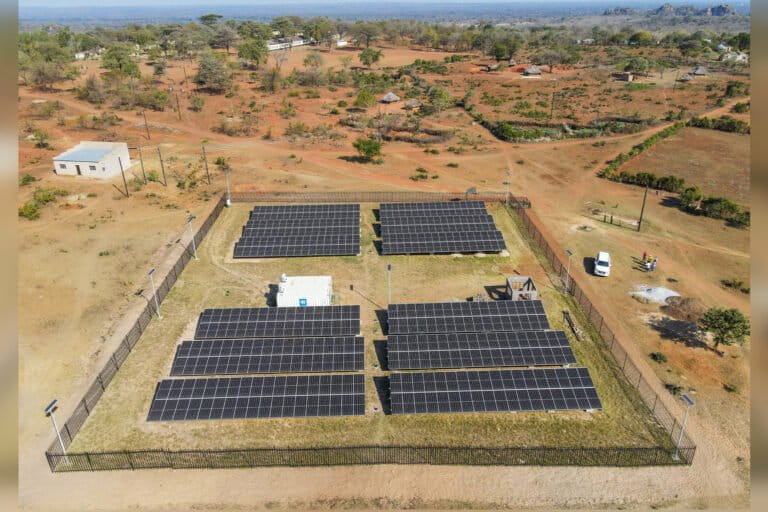
Banner image: Solar panels in Zimbabwe. Image © UNDP Zimbabwe.
John Cannon is a staff features writer with Mongabay. Find him on Bluesky and LinkedIn.
FEEDBACK: Use this form to send a message to the author of this post. If you want to post a public comment, you can do that at the bottom of the page.
Credits


