

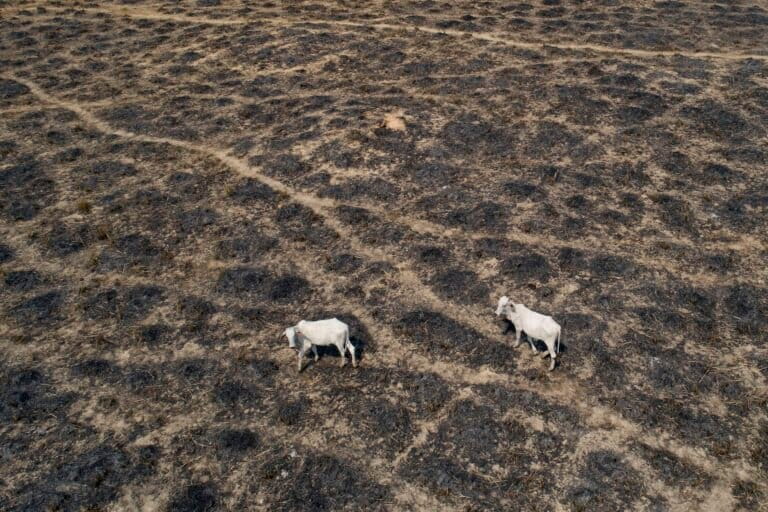
- Brazil’s Triunfo do Xingu Environmental Protection Area was established to protect a swath of the Amazon Rainforest from the cattle industry.
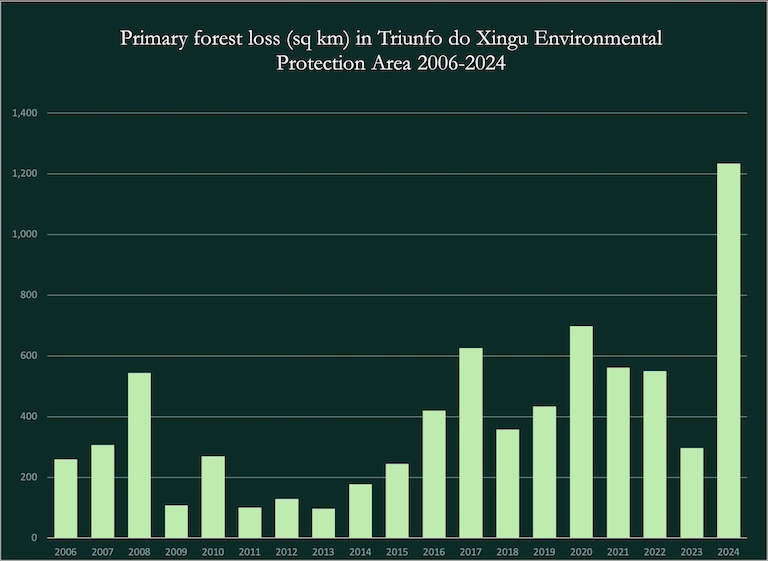
- However, satellite data show the reserve has lost around 50% of its primary forest cover since it was created in 2006.
- The data show forest loss peaked in 2024, and continued into 2025.
- Research indicates rates of deforestation are higher in Triunfo do Xingu than in the unprotected areas around it.
Brazil’s Triunfo do Xingu Environmental Protection Area encompasses an area of Amazon Rainforest more than half the size of Belgium.
Or at least it used to.
The embattled reserve has lost around half of its primary forest cover since it was created in 2006, according to satellite data from the University of Maryland’s Global Land Analysis and Discovery (GLAD) lab and visualized on monitoring platform Global Forest Watch. The data show 2024 had the highest rate of forest loss, rocketing 400% over 2023. Preliminary data show forest loss continued in 2025, concentrated in the northern portion of the 1.7-million-hectare (4.2-million-acre) reserve, where most of the largest tracts of forest remain.
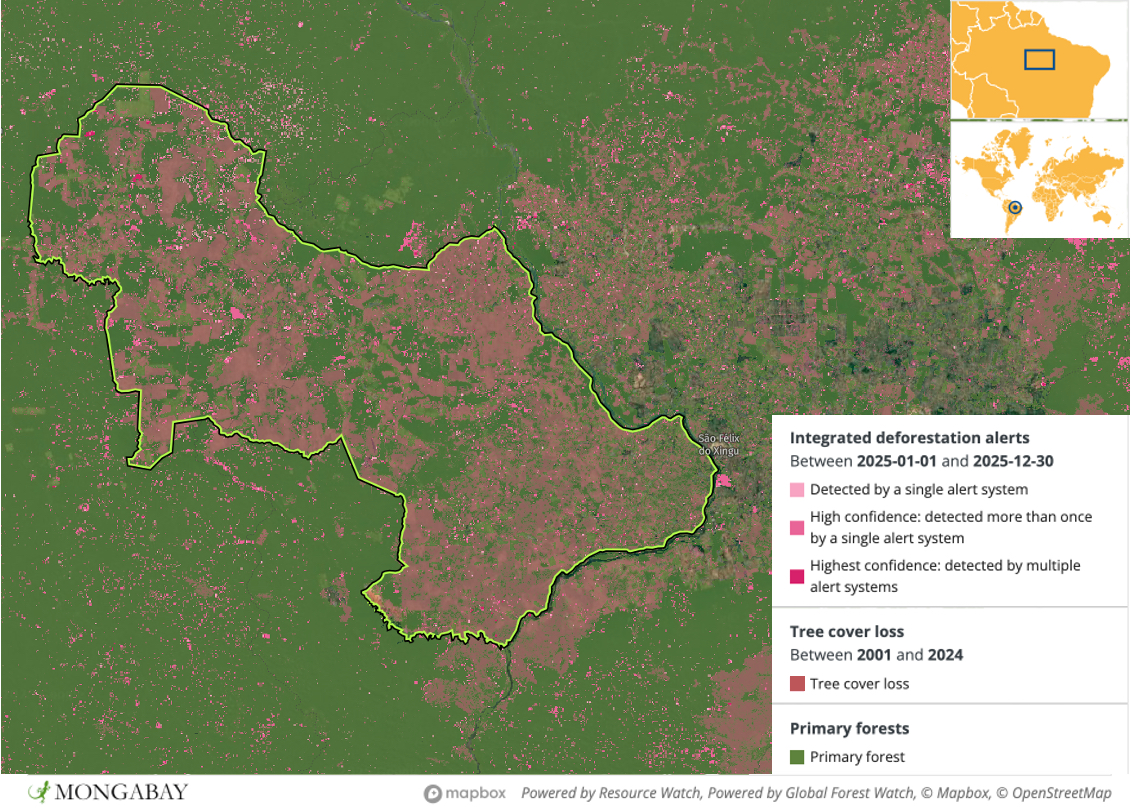
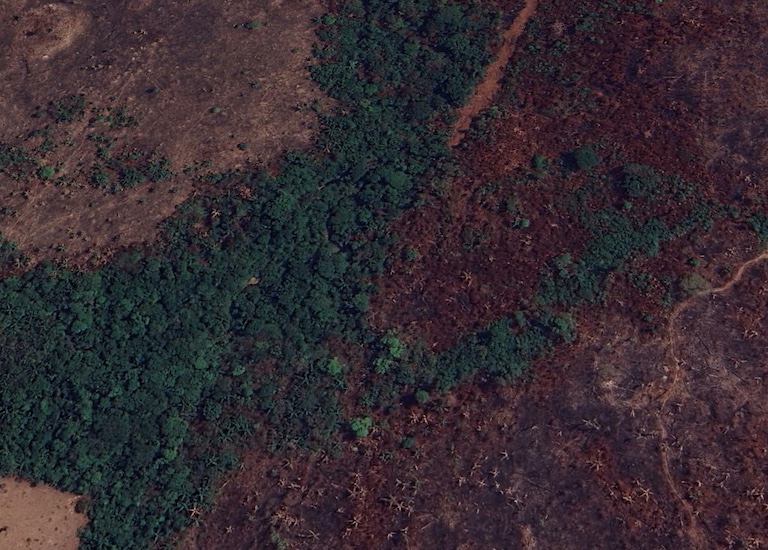
Google Timelapse shows forest loss advancing rapidly through Triunfo do Xingu.
This has given Triunfo do Xingu the dubious distinction of being the protected area with the highest rate of deforestation in the Brazilian Amazon. The main cause? Cattle.
Triunfo do Xingu lies in the heart of Brazil’s cattle country, where cows outnumber people 38 to one. To feed this legion of cattle, ranchers carve pasture from forest, often using slash-and-burn techniques to clear areas and renew degraded soil.
During a visit in 2023, Mongabay reporters observed the charred remains of sawed-down trees, and were told by local small-scale famers and officials that fires set by ranchers can spread out of control, consuming crops, homes and forest alike.
“They set one area on fire and it ends up invading their neighbor’s plot,” a state official involved in managing the reserve, who requested anonymity because he wasn’t authorized to speak to the media, told Mongabay in 2023. “And when the fire starts spreading, it becomes impossible to stop.”
Triunfo do Xingu Environmental Protection Area, also known by the Portuguese acronym APATX, was established by the state of Pará with the aim of safeguarding its forest from human impacts like ranching and logging. Some human activity is allowed in the reserve, and landowners are legally allowed to clear up to 20% of their land. However, officials said the reality on the ground is different.
“Today, you will struggle to find a farm — large or small — that has preserved 80% of its forest,” the anonymous official said in 2023.

In a study published in the Brazilian journal Geografia Ensino & Pesquisa (Geography Teaching & Research) in 2024, researchers from Brazil’s National Institute for Space Research found the extent of pasture in Triunfo do Xingu had increased by 1,468% between 2001 and 2022. They also found that forest loss in the reserve could be grouped into three distinct periods: a high rate between 2002 and 2007; a reduced rate between 2008 and 2012, after the area was declared protected; and a resumption of a high rate starting in 2013.
“Surprisingly, APATX exhibited deforestation rates that were similar to or even higher than those observed in areas outside of it,” the authors write. “This indicates that APATX, a highly important area for conservation in the Amazon, failed to effectively curb deforestation in a critical region of agricultural expansion, where the conversion of forests into pastureland serves as the primary driver of deforestation.”
The authors urged the government of Pará to “address the challenges hindering the efficient management” of the Triunfo do Xingu reserve, including developing a comprehensive management plan that guides and monitors land use and ensures compliance with environmental regulations. They also recommended establishing “strategic partnerships with various sectors” to help preserve and restore the reserve’s forests.
Banner image: Cattle graze on land recently burned and deforested by cattle ranchers near Novo Progresso, Para state, Brazil, Sunday, Aug. 23, 2020. Image courtesy of AP Photo/Andre Penner.
Citation:
Neto, M. R. R., Moraes, D. R. V., Messias, C. G., Soler, L., Almeida, C. A., & Camilotti, V. L. (2024). The ineffectiveness of the Triunfo do Xingu Environmental Protection Area in curbing deforestation in the Brazilian Amazon. Geografia Ensino & Pesquisa, 28, e85447. doi:10.5902/2236499485447
FEEDBACK:Use this form to send a message to the editor of this post. If you want to post a public comment, you can do that at the bottom of the page.
Credits


