

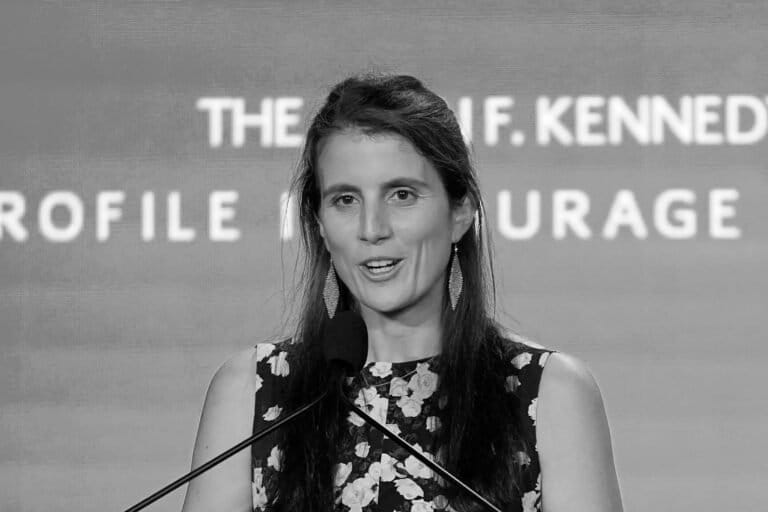
- Tatiana Schlossberg was an environmental journalist who focused on how climate damage accumulates through systems most people rarely see, favoring explanation over exhortation in her reporting and writing.
- Her work, including the book Inconspicuous Consumption, traced the environmental costs embedded in ordinary life, arguing that responsibility is shaped less by individual choices than by infrastructure and incentives.
- In November 2025 she published an essay describing her terminal leukemia, diagnosed shortly after the birth of her second child, writing about illness with the same precision she brought to reporting.
- Her final writing centered on interruption, care, and memory, including the knowledge that her children would grow up with only fragments of her presence.
She wrote about damage that accumulated slowly, in places most people did not look, and about the systems that allowed it to be ignored. When her own life was overtaken by illness, she approached that, too, as a problem to be understood rather than transcended. She died today, aged 35, after a year and a half spent moving between hospital rooms and home, and between reporting and waiting.
For much of her career she worked as an environmental journalist, explaining climate change and biodiversity loss without relying on apocalyptic framing. Her reporting for The New York Times favored mechanisms over exhortation. She was interested in how harm became normalized: how energy use hid inside data centers, how consumption displaced pollution elsewhere, how environmental cost was made abstract enough to live with. She resisted the consolations of individual virtue, arguing instead that climate change was sustained by systems that rewarded convenience and obscured responsibility.
That reporter was Tatiana Schlossberg. In 2019 she published Inconspicuous Consumption, a book that traced the environmental consequences of ordinary life, not to assign blame but to show how difficult it had become to opt out of damage once it was built into infrastructure and supply chains.
That same method shaped the essay she published in The New Yorker in November 2025, announcing that she had terminal cancer. The diagnosis came hours after the birth of her second child in May 2024, when a routine blood test showed a white-cell count that could not be dismissed. The disease was acute myeloid leukemia, with a rare mutation that made cure unlikely. She described the sequence plainly: chemotherapy, a bone-marrow transplant from her sister, remission, relapse, further treatment, another transplant, more relapse. There was no redemptive arc. Treatment worked until it didn’t.
What the essay dwelled on was interruption. She had been healthy, athletic, and absorbed in work that assumed time would cooperate. Illness arrived as a rupture, breaking a life in two at the moment it was expanding to include another child. She wrote about the indignities of care without sentimentality, and about humor as a way of remaining recognizable to herself inside a system designed for efficiency rather than dignity.

The most painful passages concerned her children. Her son, old enough to notice absence, visited the hospital so often that staff bent rules to let them sit together. Her daughter, born into the illness, grew while physical contact became dangerous. Schlossberg worried, without ornament, about memory. Her son might retain some. Her daughter might not. She treated it as fact.
Her final months sharpened the argument she had long made as a reporter: that lives depend on systems whose fragility is easy to ignore until one is forced inside them. She wrote about nurses, doctors, research funding, and clinical trials with the same attention she had once given to fisheries management or energy grids. The point was continuity.
She had planned to write a book about the oceans. She did not. Instead she left a final piece that read less like a farewell than a record, attentive to detail until the end. Near its close, she described trying to stay with her children despite knowing that presence would soon end. Being in the present, she wrote, was harder than it sounded. She kept trying anyway.
Tatiana Schlossberg. Photo by Steven Senne/Associated Press
Credits


