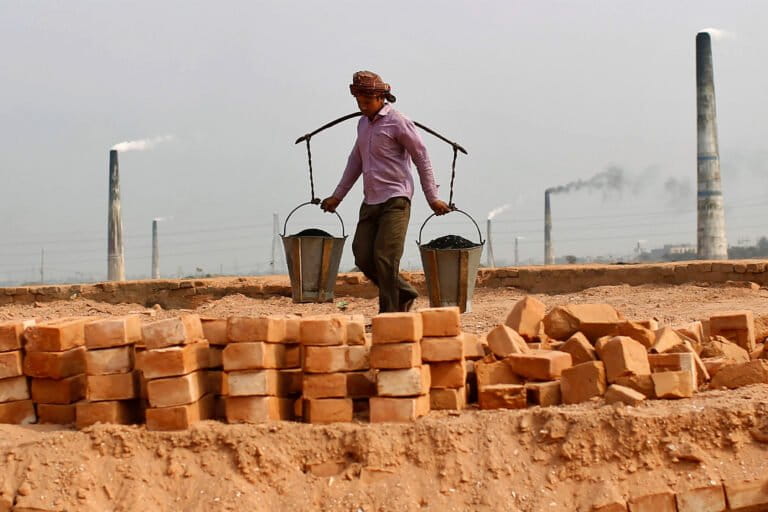
- Despite a 2019 mandate to switch to concrete blocks and other alternatives by June 2025, most government projects continued using clay-fired bricks, with only the Ministry of Housing and Public Works fully complying.
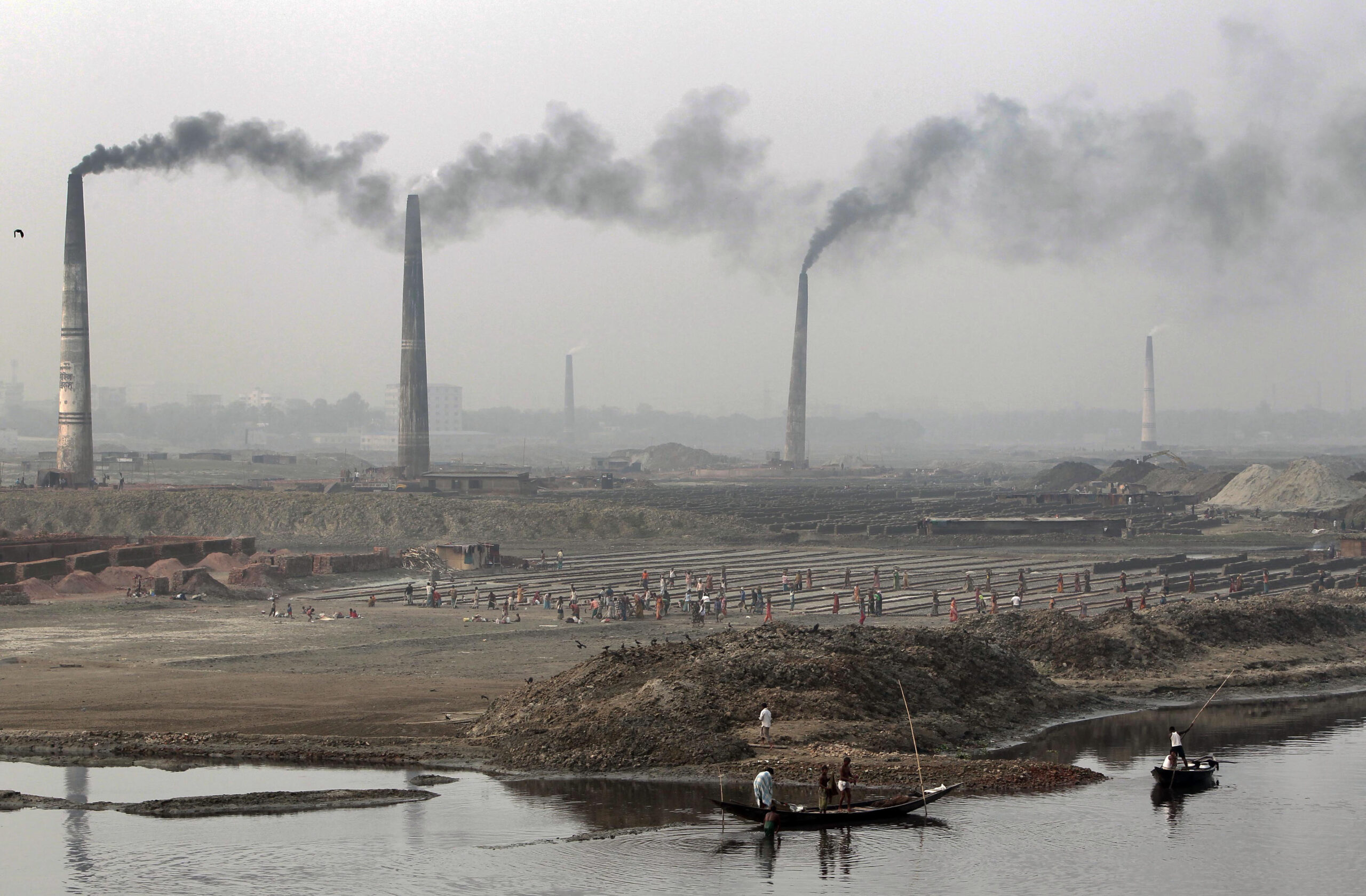
- About 7,000 brickfields strip an estimated 9.5 million cubic meters (3.35 billion cubic feet) of topsoil each year, rendering farmland uncultivable for years, while the sector accounts for roughly 3% of Bangladesh’s greenhouse gas emissions due to coal- and wood-fired kilns.
- Concrete alternatives are available, along with government-developed lower-cost options such as compressed stabilized earth blocks made from dredged river sediment, which can cut costs and conserve topsoil, yet their adoption remains limited.
- A 15% VAT on alternative building materials has made them less competitive than traditional bricks, discouraging investment and demand, even as officials plan a new deadline and stricter enforcement to revive the stalled transition.
In 2019, Bangladesh set a target to end the use of traditional bricks and switch to concrete blocks in all government construction works by June 2025. Aimed at preventing the loss of farmland and the high greenhouse gas emissions associated with brickmaking, the result has largely been “a failure,” according to a top official.
“Initially, our target was to use concrete blocks and hollow bricks in all kinds of government works including building public infrastructures, roads, etc.,” Syeda Rizwana Hasan, an adviser to the Ministry of Environment, Forest and Climate Change (MoEFCC), told Mongabay. “Unfortunately, most of the government works have continued to be carried out with the traditional bricks, which mostly made the target a failure.”
Various government departments run a wide range of construction projects, including the Ministry of Housing and Public Works, the Education Engineering Department and the Roads and Highways Department.
“Of them, only the public works ministry reached its use of 100% clean materials while the others are far behind the target,” Hasan said.
Md. Ziuaul Haque, additional director-general of the Department of Environment, said a new deadline for the transition is being planned. “As per our estimation, around 30-40% of the total government works have come under the use of alternative building materials so far,” he said. “We are planning to set a new timeline and impose strict directions to the related government agencies to meet the goal of 100% use of clean bricks.”
Damaging to land and climate
A boom in infrastructure and development projects across Bangladesh in recent years, both public and private, has led to rising demand for construction materials, including bricks. But the red clay bricks widely used in the industry are made from topsoil, and stripping away this fertile layer has rendered vast swaths of land across the country no longer suitable for farming.
The Department of Environment estimates that the 7,000 or so brickfields throughout the nation use about 9.5 million cubic meters (3.35 billion cubic feet) of topsoil or clay to produce around 23 billion bricks annually. The land from which it’s taken remains uncultivable for at least the next three years, which ultimately reduces the area available for agricultural production.
Another criticism of the traditional brickmaking process is that firewood and coal are needed to fire the kilns to bake the bricks, contributing to GHG emissions. According to Bangladesh’s emissions reduction commitment under the Paris climate agreement, the brickmaking industry is responsible for about 3% of the country’s total emissions.
Alternatives mandated — but not supported
In light of these problems, a 2019 law redefined “bricks” to include concrete blocks and other alternative construction units not made from topsoil or needing to be fired in a kiln. As part of efforts to implement the law, the government mandated the phaseout of traditional bricks and full adoption of alternatives in government projects by mid-2025.
To that end, it commissioned the Bangladesh Housing and Building Research Institute (HBRI) to develop alternatives. Through their research and development, HBRI showed how the nation could save an enormous amount of topsoil by using alternative building materials, most commonly cement, but also including sand, dredged soil, and iron mesh.
One example, known as compressed stabilized earth block (CSEB), is made from cement mixed with dredged river sediment. Its production cost is about half that of traditional kiln-fired bricks, according to the HBRI.
However, demand for these alternatives has been weak, in large part because of an additional tax that the government levies on these products, producers say. They say this has made concrete blocks and other alternatives less cost-competitive.
“Despite the capacity to meet the country’s total demand of bricks, we can’t produce enough clean bricks in the country as investors do not get adequate profit from their venture,” said Mohammad Shakhawat Hossain, president of Bangladesh Concrete Blocks & Pavers Manufacturer Society.
“Currently we are paying 15% [value-added tax] on top of the production cost, which hampers the return of the investment in some cases. For conventional brickmakers, the rules are different,” he said, noting they only pay a flat rate for the first batch of half a million bricks that they produce. “[That’s what] makes the difference.”
Hossain added that “if we can lower the price of the product [compared to] the conventional one, the demand will ultimately rise among the users.”
Banner image: A worker carries coal in buckets to burn bricks at a brick field in Savar, near Dhaka, Bangladesh. Image by AP Photos/A.M. Ahad.
To save topsoil & reduce pollution, Bangladesh moves toward alternative bricks
Citations:
Biswas, D., Gurley, E. S., Rutherford, S., & Luby, S. P. (2018). The drivers and impacts of selling soil for brick making in Bangladesh. Environmental Management, 62(4), 792-802. doi:10.1007/s00267-018-1072-z
Sarker, M. A. H., & Ishtiak, M. I. (2018). Alternative building material in Bangladesh: A way towards sustainability. International Journal of Research Studies in Science, Engineering and Technology, 5, 41-45. Retrieved from https://www.researchgate.net/publication/342261891
Feedback: Use this form to send a message to the author of this post. If you want to post a public comment, you can do that at the bottom of the page.
Credits