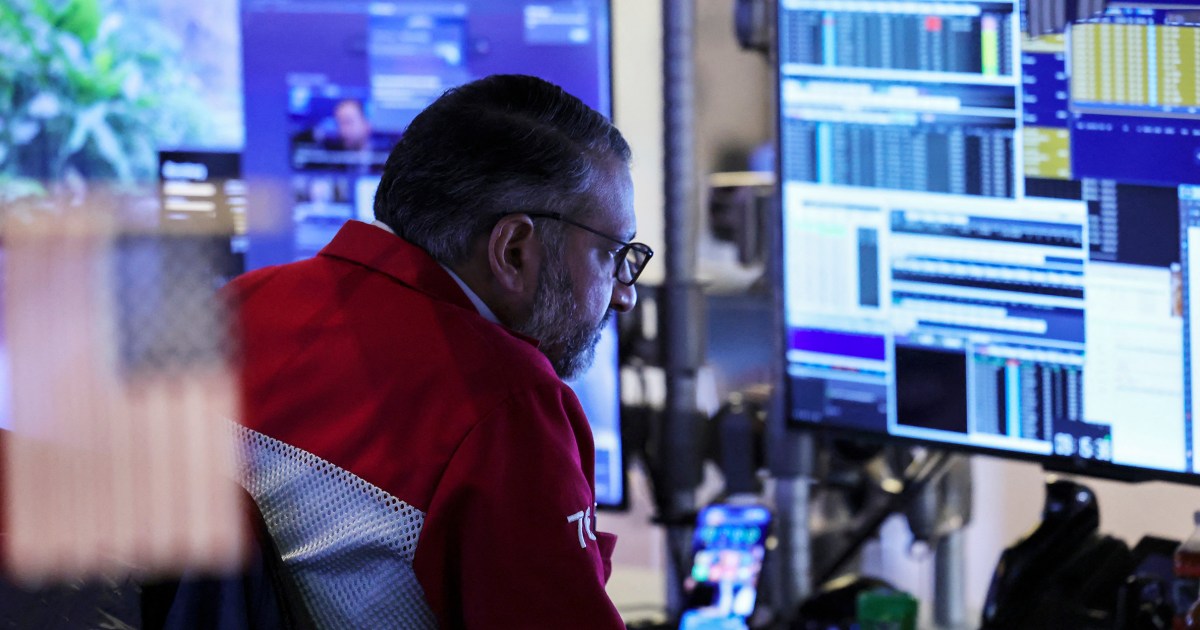
Global markets plunged Tuesday after President Donald Trump reignited fears of a U.S. trade war with the European Union, America’s largest trading partner.
Trump showed no signs of backing off his threat Saturday to hit seven E.U. countries and the United Kingdom with new tariffs unless they supported his push for American control of Greenland.
At a White House briefing Tuesday, Trump was asked how far he would be willing to go to secure control of Greenland, a semi-autonomous Danish territory. “You’ll find out,” he replied.
Monday, Trump had responded “no comment” to a question from NBC News about whether he would be willing to use force to seize the territory.
The S&P 500 ended Tuesday lower by around 2.1%, its worst day since October. The Nasdaq Composite plunged more than 2.4%.
The Dow Jones Industrial Average dropped around 870 points, just over 1.7%.
The S&P 500’s losses Tuesday erased the index’s gains for the year so far. The Nasdaq is now down more than 1% in 2026.
The selling amounted to more than $1.2 trillion in value wiped out from the S&P 500, as investors digested the global shock waves of Trump’s threat to tie U.S. tariffs to his broadly unpopular bid to acquire Greenland.
Investors also sold off U.S. government bonds, driving up interest rates. Rising returns on U.S. treasuries usually translate into higher mortgage rates and interest on new personal loans.
A global sell-off
Markets in Europe also experienced sharp drops Tuesday for the second day in a row.
Germany’s benchmark DAX index closed down 1%, Britain’s FTSE 100 ended lower by 0.7%, and Italy’s FTSE MIB slid 1.1%.
The STOXX Europe 600, Europe’s equivalent to the S&P 500, tumbled 0.7%, with a majority of stocks on the index ending the trading day in the red.
The CBOE Volatility Index, which reads like a sort of fear gauge on Wall Street, rose to its highest level since mid-November on the blizzard of risks facing investors.
Precious metals, viewed as safe haven assets in times of turmoil, also rose to record highs. Gold jumped more than 2% Tuesday, and silver was slightly higher in midday trading.
The price of silver has already risen more than 30% this year, prompting the U.S. Mint to briefly pause sales of silver collectors’ coins to reprice them.
The ICE U.S. Dollar Index, a measure of the dollar’s strength against international currencies, dropped 0.8%, nearly putting it on course for its worst day since April, when Trump announced his “reciprocal” tariff agenda and sparked a sell-off in U.S. equities and bonds.
Trump threatened even more tariffs late Monday as he boarded Air Force One in Florida.
Asked about French President Emmanuel Macron’s decision to turn down Trump’s invitation to join a “Board of Peace” that would initially focus on Gaza, Trump told reporters, “I’ll put a 200% tariff on his wines and Champagnes and he’ll join, but he doesn’t have to join.”
France’s benchmark CAC 40 stock index dropped around 0.7% Tuesday.
Fixed-income jitters
U.S. government bonds also sold off, sending yields soaring. The yield on the 10-year U.S. Treasury bond hit its highest levels since August, and 30-year yields rose to their highest levels since September.
A decision by the Japanese prime minister to call for snap elections added to bond investors’ concerns. The uncertainty was compounded by the possibility that the U.S. Supreme Court could rule in the near future on the legality of Trump’s sweeping, country-based tariffs. The court did not issue a ruling Tuesday.
When Treasury yields rise, typically so do mortgage rates and interest charged on personal loans, auto loans and more.
Higher interest rates could also complicate a domestic affordability push by the Trump administration in a U.S. election year. In recent weeks, the White House has deployed an arsenal of policy tools aimed at lowering the cost of living for U.S. consumers.
European officials say that leaders will hold an emergency summit Thursday to consider retaliating against Trump’s Greenland tariffs and that a package of more than $100 billion in counter-tariffs is at the ready.
Some E.U. leaders have also backed deploying what’s known as the bloc’s “trade bazooka,” an anti-coercion instrument created to counter hostile states like China.
The ‘sell America’ trade
“This is ‘sell America’ again within a much broader” global ripple effect, Krishna Guha of the investment bank Evercore ISI wrote Tuesday.
Guha was using a term coined in April, after Trump rolled out a global tariff agenda with sky-high rates on dozens of countries. Fearing the U.S. was no longer a reliable trade partner, investors sold off U.S. stocks and bonds and looked to metals and international stocks to help hedge the risk.
The sell-off most likely would have been worse, he said, if investors weren’t optimistic that the Supreme Court will curtail Trump’s tariff authority and that his administration will back off its latest threats of additional import duties.
“The impacts would be very severe if this goes off the rails, and there will be long-lasting implications, including for the dollar,” Guha wrote.
Citigroup’s Scott Chronert wrote in a client note, “We are only two weeks into the new year and the number and magnitude of impacts on U.S. equity markets is already dizzying.”
Sergio Ermotti, the CEO of the Swiss banking giant UBS, said, “I don’t see any path to normalization in the near future.”
“There is a limit on how many things you can put on the table without eventually one of them going out of control and then creating the kind of volatility you see now,” Ermotti said in a CNBC interview at the World Economic Forum in Davos, Switzerland.
Treasury Secretary Scott Bessent dismissed critics of the administration’s latest moves, accusing them of having “gone into hysterics.”
“The U.S. is a reliable partner,” he told CNBC in an interview Tuesday.
“Everyone take a deep breath. Do not escalate. Do not escalate,” he said. “President Trump has a strategy here. Hear him out, and then everything will be fine.”

Steve Kopack is a senior reporter at NBC News covering business and the economy.