
Welcome to this weekly housing trends update, where we bring you the latest snapshot of inventory trends, listing activity, and buyer-seller dynamics across the U.S. housing market.
In addition to our monthly housing trends reports, which offer deeper insights into long-term patterns, we publish these weekly updates to provide more timely views into market changes. This effort began in response to rapid shifts in the economy and housing landscape.
You can count on a new Weekly Housing Trends update, fresh weekly data each Thursday, and a weekly video from our economists to help you stay informed.
What this week’s data shows
The first week of February brings a mixed bag of economic signals and housing data, painting a picture of a market that is slowly finding its footing amid broader adjustments. While the partial government shutdown that began earlier in the month ended on Feb. 3 after just four days, the brief disruption added a layer of uncertainty to a week already grappling with winter weather hangovers and economic recalibration.
On the financing front, stability is the key word. The 30-year fixed mortgage rate held steady at 6.11% this week, reflecting a market that is waiting for clearer signals despite the Federal Reserve holding rates steady in January. While rates have not plummeted, the stability provides a predictable baseline for buyers. Meanwhile, broader housing metrics offer a glimmer of long-term optimism; the homeownership rate edged up to 65.7% in the fourth quarter of 2025, driven in part by younger households making meaningful gains.
However, the real-time weekly data suggests that sellers are pulling back while buyers remain patient. New listing activity dropped significantly again this week, likely a continued reaction to the severe winter weather and perhaps a pause during the brief shutdown. Consequently, price softness is cementing itself as a trend, with median listing prices showing their sharpest year-over-year declines in recent history. For buyers willing to brave the winter chill and the economic noise, the market is undeniably tipping in their favor with lower prices and less competition.
Weekly housing trends highlights
- New listings, a measure of sellers putting homes up for sale, fell by 8.5% year over year. After a sharp 13.3% decline the previous week, driven by a widespread winter storm, new listing activity remained sluggish, falling 8.5% compared to the same time last year. While an improvement over the prior week’s storm-induced low, the continued decline suggests that seller confidence may have been temporarily rattled by the combination of weather and the brief government shutdown. Sellers seem to be waiting for calmer waters before testing the market, limiting the influx of fresh inventory for early February shoppers.
- Active inventory climbed 7.5% year over year. The number of homes for sale remains above last year’s levels, giving buyers more options than they had in early 2025. However, the pace of inventory growth has slowed compared to January, reflecting the recent drop in new listings. Despite this, the year-over-year gain confirms that homes are accumulating on the market, shifting the power dynamic toward buyers who now have the luxury of choice and time.
- Homes spent 8 days longer on the market than a year ago. The market continues to slow, with homes now sitting for over a week longer than at this time last year. This is a notable increase from the 6-day gap seen throughout January, reinforcing signs of softer demand. As buyers weigh their options amid steady mortgage rates and economic headlines, sellers are facing a market that requires patience. This extended time on the market goes beyond normal seasonal cooling, indicating a fundamental shift in buyer urgency.
- The median listing price fell 2.4% year over year. For the second consecutive week, the median listing price dropped by 2.4% compared to the previous year. This consistent decline represents a significant adjustment in seller expectations as they adapt to a market with slower sales and price-sensitive buyers. With mortgage rates hovering near 6.11%, this price softening is a critical component in restoring affordability and enticing buyers back to the table.
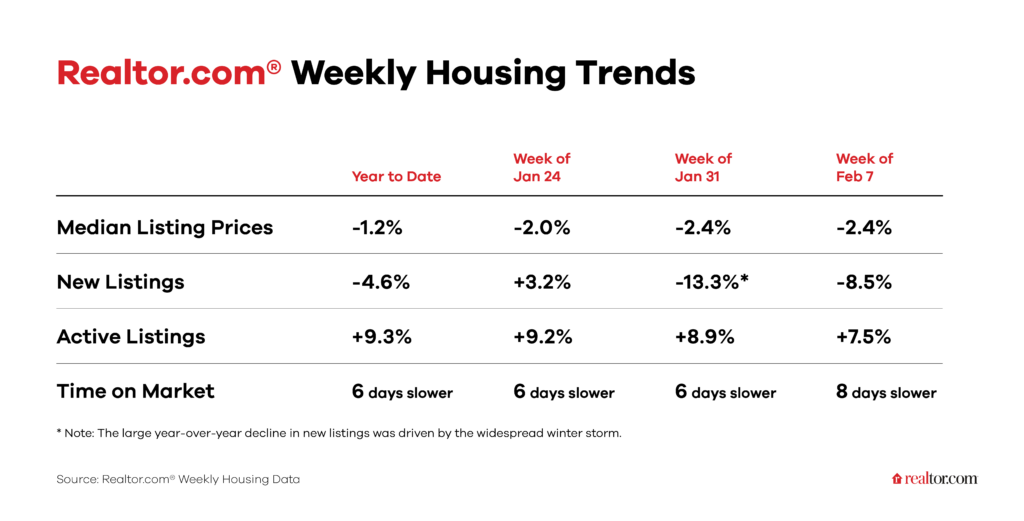
Note: The large year-over-year decline in new listings was driven by the widespread winter storm.