
National News
Without habeas filings, Mahmoud Khalil, Mohsen Mahdawi, and Rumeysa Ozturk, three of the most prominent demonstrators detained by federal agents this year, might still be detained or already have been deported.

By Colin Moynihan, New York Times Service
5 minutes to read
Share
Share
Send this article to your social connections.
NEW YORK — Student protesters detained by the Trump administration in deportation proceedings have relied on a centuries-old legal vehicle to have judges determine whether they were punished for exercising their First Amendment rights and might be entitled to release.
Now, the government is seeking to convince a New York appeals court that the tool, a habeas corpus petition, should be generally off-limits in such cases, arguing that it runs afoul of American immigration law.
If the U.S. argument is successful, noncitizens detained by the administration and placed in immigration proceedings could lose one of the most dependable methods of challenging their detention.
Without habeas filings, Mahmoud Khalil, Mohsen Mahdawi and Rumeysa Ozturk, three of the most prominent demonstrators detained by federal agents this year, might still be detained or already have been deported.
American Civil Liberties Union lawyers representing Ozturk, who was a graduate student at Tufts University in Massachusetts when she was arrested this year, and Mahdawi, who helped organize pro-Palestinian demonstrations at Columbia University in New York City, appeared at a hearing Tuesday in the 2nd Circuit Court of Appeals in Manhattan.
A Justice Department lawyer, Tyler Becker, repeatedly laid out the government’s position before a three-judge panel, saying that Congress had stripped from federal district courts the jurisdiction to consider habeas petitions that challenged deportation decisions.
The lawyers representing Mahdawi and Ozturk countered that contesting a decision to remove someone from the United States is different from contesting a decision to detain that person. They said district courts clearly have the authority to hear habeas cases brought by people who contend that they are being held in violation of the law.
Mahdawi and Ozturk both have active habeas cases in which they have asked the court to declare that the government’s actions violated the First and Fifth Amendments and to vacate what they call an unlawful policy of targeting noncitizens for removal from the country based upon advocacy for Palestinian rights.
Those cases have been on hold pending decisions by the 2nd Circuit. Mahdawi and Ozturk also face separate deportation proceedings.
The cases have become a focus of the Trump administration’s efforts to quash pro-Palestinian dissent on campus, particularly when it involves students from other countries. On Tuesday, a federal judge in Massachusetts ruled that the administration threatened students with deportation to silence noncitizens in academia, specifically mentioning the three involved in the New York appeal.
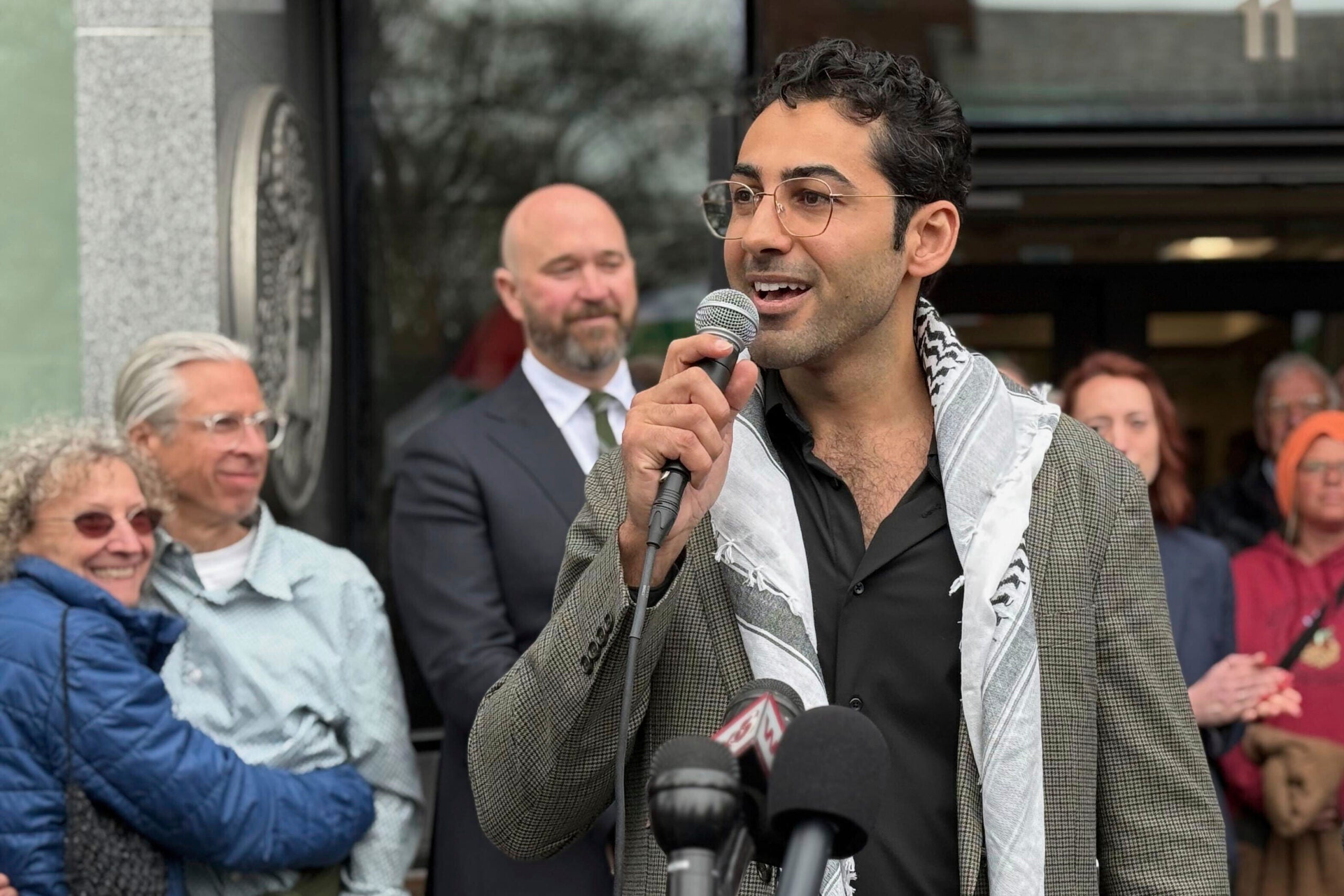
On the eve of the appeals hearing, Mahdawi spoke to demonstrators rallying outside Columbia University. “There is an opportunity for us to come together and to reclaim our university, to reform the governance in this university, to stand up for the principles and the values that we come to this university for and to stand up against any form of injustice, against tyranny and against fascism,” Mahdawi told the crowd.
If the government ultimately gets its way, Madhawi, who grew up in a Palestinian refugee camp in the West Bank, would have to make such arguments from abroad.
The administration is asking for the reversal of orders by two district court judges who considered habeas petitions earlier this year. One judge released Mahdawi on bail; the other brought Ozturk from Louisiana, where she had been in a detention facility, to Vermont, where she was released soon after her arrival.
But even if those requests are specific, the implications for habeas and its uses could be broad.
The right to invoke habeas, derived from centuries of common law dating back to the time of Magna Carta, is widely seen as a foundational part of constitutional democracy, one that protects people from unlawful detention. It is cited in the Constitution, where the framers wrote that it “shall not be suspended, unless when in Cases of Rebellion or Invasion the public Safety may require it.”
In recent months, habeas has become a lightning rod for government officials who have pushed for deportations.
President Donald Trump’s deputy chief of staff, Stephen Miller, said in May that the administration would consider suspending habeas for detained migrants, something that several legal experts said was beyond the ability of the executive branch alone. Stephen Vladeck, a law professor at Georgetown University, called Miller’s statement “factually and legally nuts.”
When Homeland Security Secretary Kristi Noem was asked shortly after Miller’s statement to define habeas, she misidentified it as “a constitutional right that the president has to be able to remove people from this country.”
“Excuse me, that’s incorrect,” Maggie Hassan, a U.S. senator from New Hampshire, replied, adding: “Habeas corpus is the legal principle that requires that the government provide a public reason for detaining and imprisoning people.”
It was once common to use habeas to challenge deportation orders, but changes to the Immigration and Nationality Act in 1996 and 2005 limited district courts’ authority to review those decisions.
Administration lawyers cited those changes, writing to the appeals panel that immigration law requires a noncitizen “to exhaust all issues first in immigration court,” and then through the Board of Immigration Appeals. Only then, the lawyers added, may a noncitizen seek review of legal, constitutional or factual questions by petitioning an appeals court.
The ACLU called that position “radical,” saying that the law does not require anyone to go through an immigration review process that can last years before challenging unconstitutional detention in a federal court.
That, the ACLU lawyers added, “would give the executive branch a powerful tool of unchecked censorship — the ability to detain noncitizens as punishment for their political viewpoints.”
Steven Menashi, one of the judges hearing arguments Tuesday, seemed sympathetic to some aspects of the government’s case. He suggested that while habeas petitions may be appropriate when challenging a prolonged detention, it might be reasonable for most detainees to exhaust their options in immigration court before turning to a federal court.
Another judge, William Nardini, appeared receptive to the idea that an allegation of unconstitutional detention would be enough for habeas review.
Nardini asked Becker whether an immigration judge could release someone held in violation of the First Amendment. Becker replied that the immigration judge would have that discretion.
Nardini asked whether an immigration judge in the hypothetical situation he described would be bound to grant release.
“Given that the release is discretionary,” Becker said. “I don’t want to take a position.”
This article originally appeared in The New York Times.
Extra News Alerts
Get breaking updates as they happen.