

commentary
In 2025, the veep warned Europeans about censorship. Now the Trump administration is testing those same limits
Published
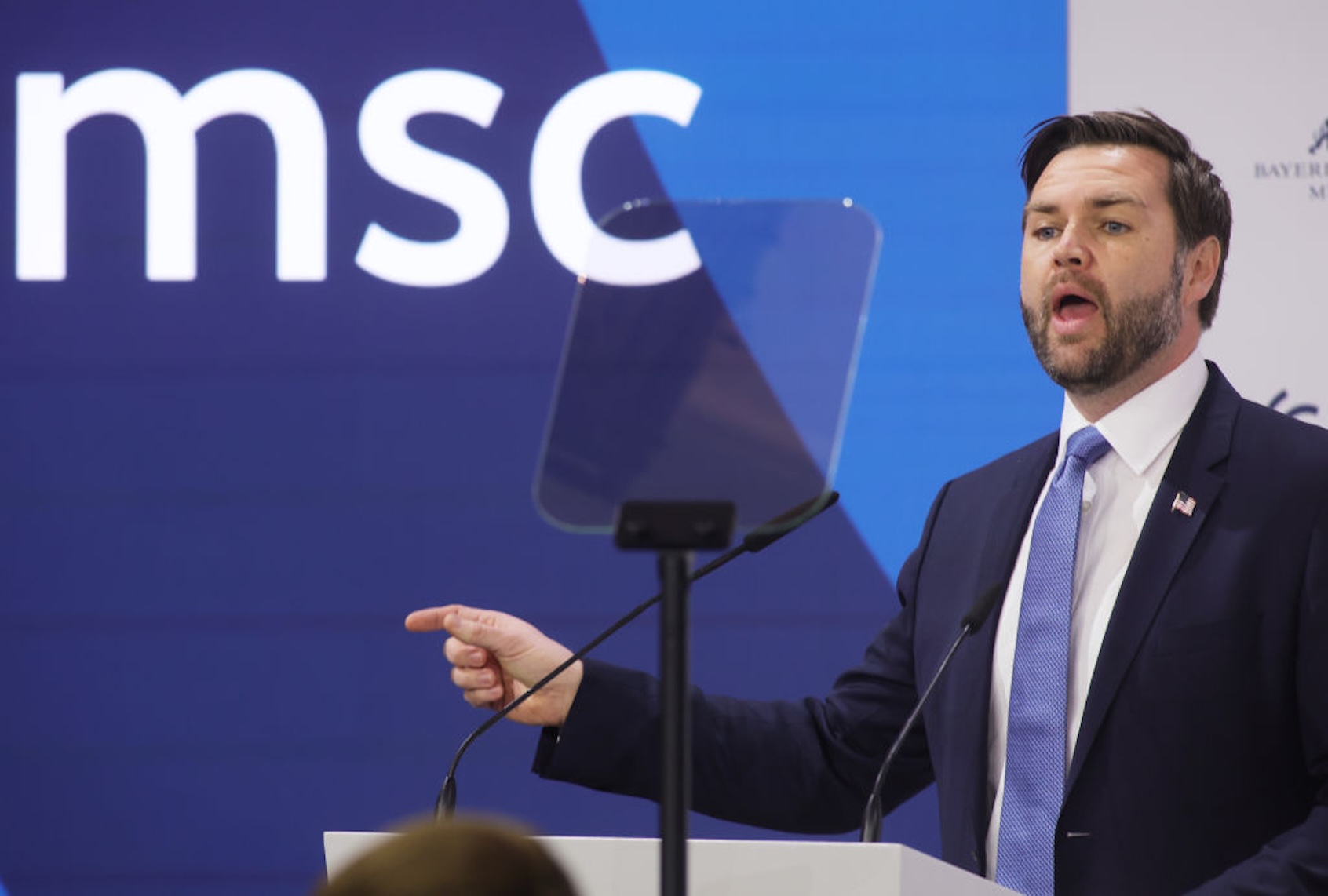
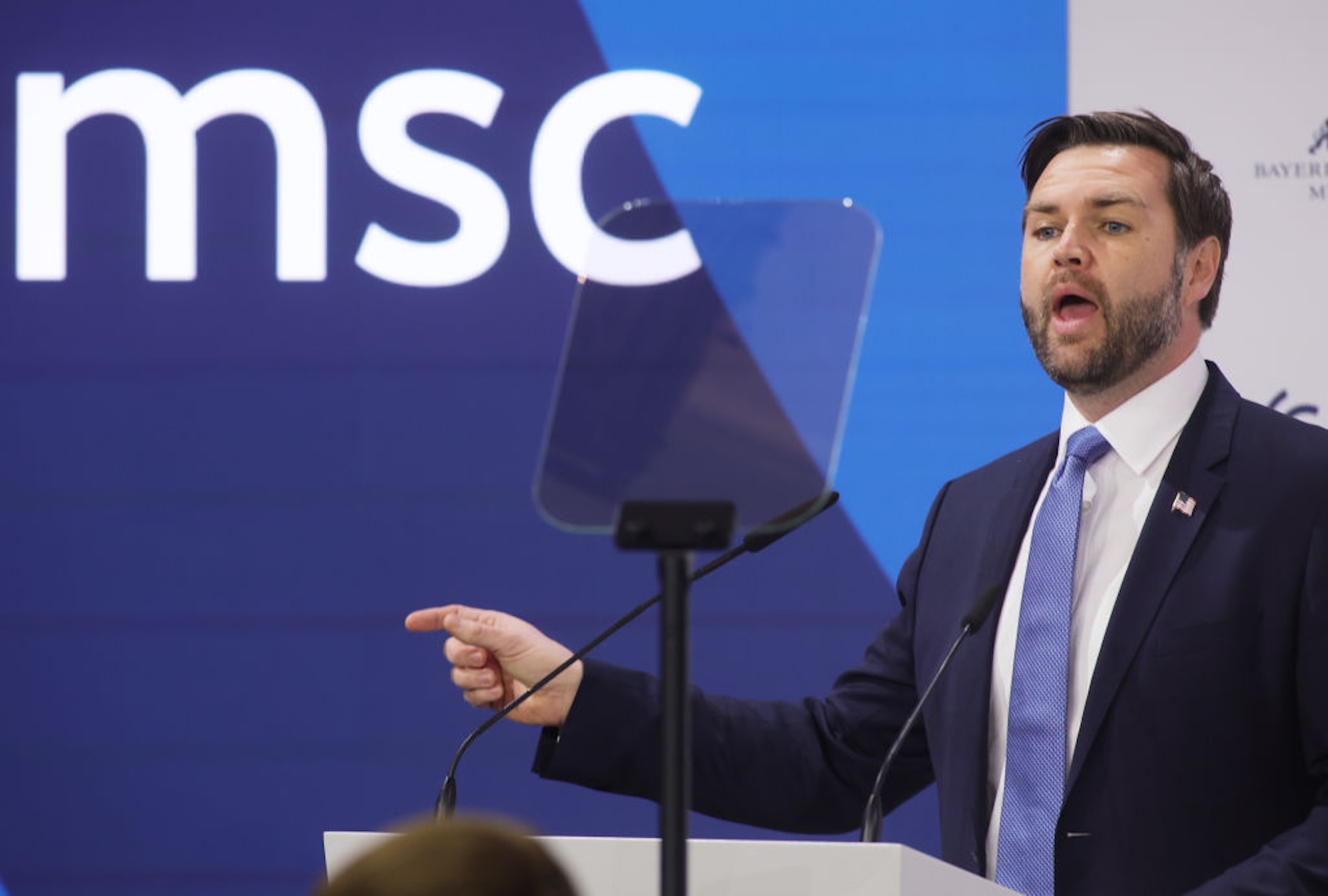
At the 2025 Munich Security Conference, Vice President JD Vance chided Europeans on limiting free speech. (Johannes Simon/Getty Images)
On Feb. 14, 2025, newly-inaugurated Vice President JD Vance made his first official trip to Europe to attend the annual Munich Security Conference. Instead of the usual warm embrace and pledge of continued cooperation, Vance delivered a scathing indictment of their policies and their principles.
As the New York Times reported at the time, his speech “stunned and silenced [the] hundreds of attendees” and “offered…a preview” of what would be the administration’s disdainful attitude toward the “trans-Atlantic relationship.” Instead of focusing on the threats posed by China and Russia, Vance urged Europeans to focus on what he called “the threat from within,” a variation of “the enemy within,” a phrase used by Donald Trump to describe his domestic political opponents. The term carried an especially chilling, historical weight at a conference held in Germany; Nazis had used it in their aggressive propaganda campaign against Jews, Communists and others the government wanted to demonize.
“What I worry about is the threat from within, the retreat of Europe from some of its most fundamental values — values shared with the United States of America,” Vance said, spinning falsehoods about free speech violations in Europe, while denouncing immigrants and defending right-wing extremist groups. “If you are afraid of the voices, the opinions and the conscience that guide your very own people … If you’re running in fear of your own voters, there is nothing America can do for you, nor for that matter is there anything you can do for the American people who elected me and elected President Trump.”
While Vance’s words received gushing praise on Russian state television, members of the audience were stunned and refused to applaud. They marked the first definitive sign that the transatlantic alliance, which had survived for nearly 80 years, had fractured.
While Vance’s words received gushing praise on Russian state television, members of the audience were stunned and refused to applaud. They marked the first definitive sign that the transatlantic alliance, which had survived for nearly 80 years, had fractured.
One year later, after mounting the greatest sustained attack on the First Amendment since the McCarthy era, members of the Trump administration and the vice president himself should reread his speech and apply its robust defense of free speech to groups they dislike in this country.
That is, of course, a pipedream.
The administration’s version of free speech encourages the expression of views by its friends and chills the expression of those it perceives as enemies. Vance and Trump believe that the United States is in a battle for the survival of “civilization” — by which they mean Christian, capitalist, conservative civilization.
There is nothing subtle about what they are doing. That’s why they label opponents as “enemies within,” and speech they disapprove of as treason.
Both the president and vice president have used the clash-of-civilizations frame many times. In 2017, during his first term, the president called on an audience in Poland to “summon the courage and the will to defend our civilization.” He asked them to recognize “dire threats to our…way of life” and to take confidence that “Our adversaries are doomed because we will never forget who we are.”
Trump defined Western identity this way: “We write symphonies. We pursue innovation. We celebrate our ancient heroes, embrace our timeless traditions and customs, and always seek to explore and discover brand-new frontiers. We reward brilliance. We strive for excellence and cherish inspiring works of art that honor God.”
Then returning to his central theme, he observed that the “fundamental question of our time is whether the West has the will to survive… Do we have enough respect for our citizens to protect our borders? Do we have the desire and the courage to preserve our civilization in the face of those who would subvert and destroy it?”
Who do Trump and Vance believe would subvert and destroy it? The answer is clear: They include people like comedians Stephen Colbert, Jimmy Kimmel and Trevor Noah; the producers of “60 Minutes,” or at least before Bari Weiss assumed control of CBS News; and Democratic Sens. Mark Kelly of Arizona and Elissa Slotkin of Michigan, as well as Reps. Maggie Goodlander of New Hampshire, Jason Crow of Colorado, and Chrissy Houlahan and Chris DeLuzio of Pennsylvania, all of whom made a video telling service members that they should refuse to carry out unlawful orders.
Trump called them “traitors to our Country [who] should be ARRESTED AND PUT ON TRIAL.”
Last September, following the killing of MAGA influencer and Turning Point USA founder Charlie Kirk, the president also issued an executive order targeting what he called “organized campaigns of targeted intimidation, radicalization, threats, and violence…” He pledged to implement “a new law enforcement strategy” to go after his perceived enemies, “including the organized structures, networks, entities, organizations, funding sources, and predicate actions behind them…”
While Trump said such conspiracies are “designed to silence opposing speech,” it is clear that was exactly what his executive order was designed to do. He aimed to go after people who “portray foundational American principles (e.g., support for law enforcement and border control) as ‘fascist.’”
Want more sharp takes on politics? Sign up for our free newsletter, Standing Room Only, written by Amanda Marcotte, now also a weekly show on YouTube or wherever you get your podcasts.
“This ‘anti-fascist’ lie,” Trump continued, “has become the organizing rallying cry used… to wage a violent assault against democratic institutions, constitutional rights, and fundamental American liberties.” He vowed not to tolerate “anti-Americanism, anti-capitalism, and anti-Christianity…”
The clash of civilizations and enemies from within approaches were central to what Vance said last year in Munich. He asked his listeners to show that they prize “all of the extraordinary blessings of liberty, the freedom to surprise, to make mistakes, to invent, to build” while bemoaning that, in Europe, “police have carried out raids against citizens suspected of posting anti-feminist comments online as part of, quote, ‘combating misogyny on the Internet, a day of action.’”
“Under Donald Trump’s leadership,” Vance assured his listeners, “we may disagree with your views, but we will fight to defend your right to offer it in the public square, agree or disagree….I believe that dismissing people, dismissing their concerns, or, worse yet, shutting down media, shutting down elections, or shutting people out of the political process protects nothing. In fact, it is the most surefire way to destroy democracy.”
Vance is right about the way to destroy democracy. The rest, as former president Joe Biden would say, is malarkey.
What happened to Vance’s ardent defense of free speech when the president demanded that Mark Kelly and his colleagues be tried for treason for making truthful statements about soldiers’ obligations? Here is what the vice president said: “If the president hasn’t issued illegal orders, them [sic] members of Congress telling the military to defy the president is by definition illegal.” Of course, that is double-speak. Kelly and his colleagues did not encourage anyone to “defy the president.”
In the world that Trump and Vance want to create, as Will Creeley, legal director of the Foundation for Individual Rights and Expression, observed, “Your right to say something depends on what the administration thinks of it, which is no free speech at all.”
Memories may be short in politics, and Vance may have forgotten what he said a year ago in Munich. But Americans should not allow themselves to be gaslighted by all his talk about free speech.
Since then, Vance has cheered on the president’s repeated attacks on the First Amendment and has become not only a hypocrite but also a willing participant in curtailing free expression in the United States.
Related Topics
——————————————
Related Articles


