
Image: Arm
Summary created by Smart Answers AI
In summary:
- PCWorld reports that Arm has launched its first chip, the Arm AI CPU, marking a major shift from licensing intellectual property to manufacturing silicon directly.
- The processor features 136 Neoverse V3 cores designed for AI data centers and promises double the performance per rack compared to x86 CPUs.
- This strategic move into hardware production represents what Arm’s CEO calls a “defining moment” for the smartphone and PC architect.
The architect of many modern smartphones and some PCs, Arm Ltd., just put on a hard hat and picked up a hammer and a nail.
Arm, whose intellectual property formed the blueprints of smartphones designed by Apple, Qualcomm, and Samsung, said Tuesday afternoon that it has entered the chip market with help from Meta. However, its first effort will target the data center, rather than the PC or phone.
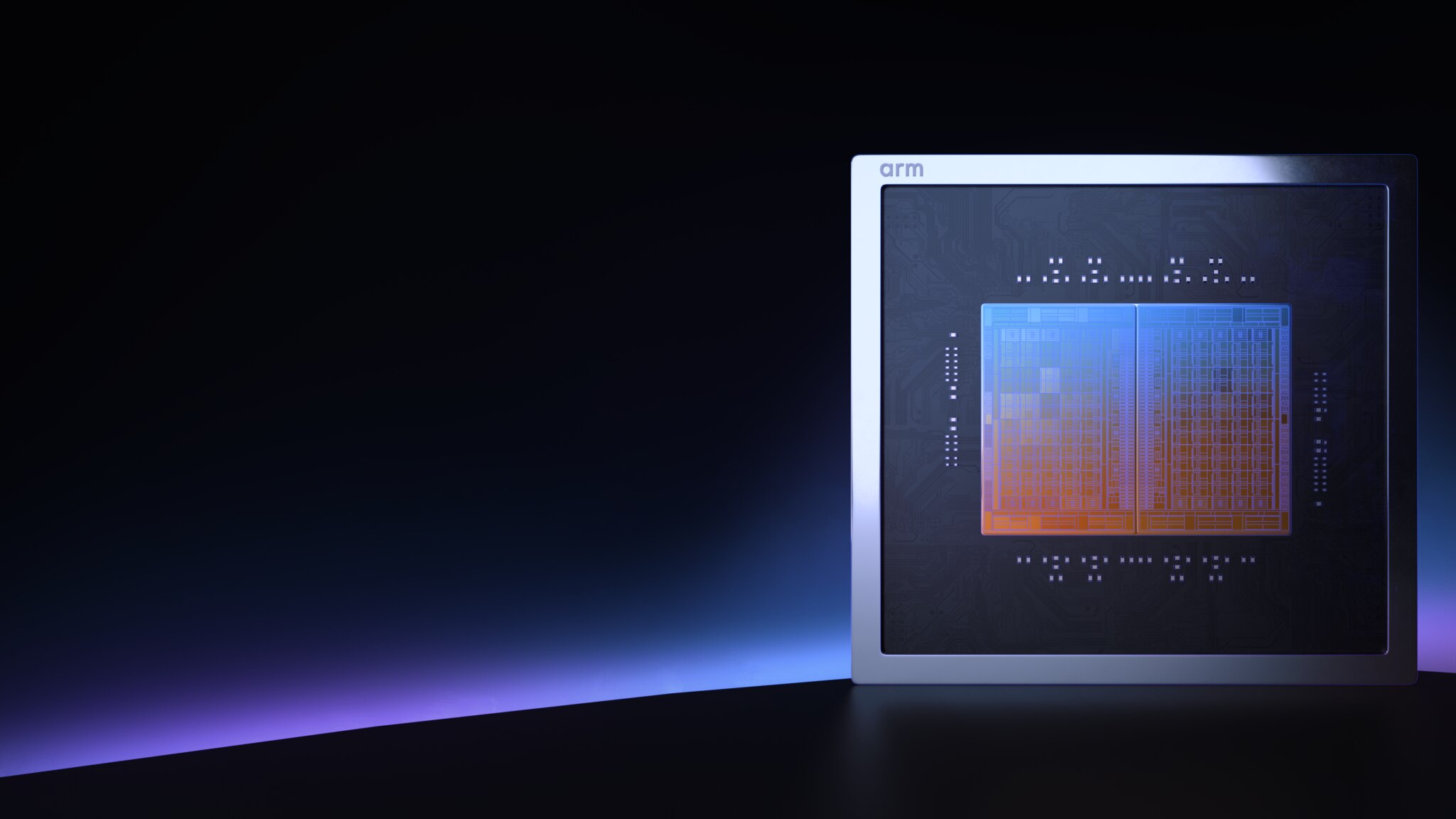
Arm’s first chip will be called the Arm AI CPU, designed for “AI data centers running agentic AI workloads” — most likely, powering Meta’s own AI efforts in the cloud. The chip, with 136 Arm Neoverse V3 cores per CPU, will be designed for 1U racks. It will offer twice the performance per rack as an x86 CPU, the company said.
“AI has fundamentally redefined how computing is built and deployed. Agentic computing is accelerating that change,” said Rene Haas, chief executive of Arm, in a statement. “Today marks the next phase of the Arm compute platform and a defining moment for our company.
Arm was founded in 1990 as Advanced RISC Machines as a joint venture between Apple, Acorn Computer, and VLSI Technology. Its architecture helped underpin the Apple Newton, according to its corporate history. However, Arm executives realized that the business couldn’t be built upon a single product and the company altered its business model to supply what’s known as intellectual property, or the design of the chips themselves. It then licensed that IP to customers.
Arm’s current license agreements comprise two models: one that takes Arm’s processor designs and bakes them into silicon, unchanged; and a “black box” architecture license. The latter is what customers like Apple and Samsung have: the freedom to design whatever chip they’d like, as long as it uses the Arm instruction set architecture.
It has traditionally been left up to Arm’s customers to actually turn Arm’s design into silicon. Over 50 ecosystem players endorsed Arm’s decision including chip suppliers Mediatek, Micron, Marvell, and ST Micro. Major customers Apple and Qualcomm were not among them, though Nvidia was.
Arm has been rumored to move into the silicon space for some time. Arm’s partnership with Nvidia, the N1/N1X, is also expected to take place this year. Arm has also tipped its own roadmap for cores specifically designed for PCs and phones, called Niva and Lumex, respectively.
Still, Arm gave no indication that it would compete with its customers in the PC or smartphone market. The silence of its major customers could be a tell. Who knows if your next phone or PC will include a microprocessor with “Arm” stamped upon it?
Editor’s note: This article originally stated Nvidia did not announce support for Arm’s move. We apologize for the error.
Author: Mark Hachman, Senior Editor, PCWorld

Mark has written for PCWorld for the last decade, with 30 years of experience covering technology. He has authored over 3,500 articles for PCWorld alone, covering PC microprocessors, peripherals, and Microsoft Windows, among other topics. Mark has written for publications including PC Magazine, Byte, eWEEK, Popular Science and Electronic Buyers’ News, where he shared a Jesse H. Neal Award for breaking news. He recently handed over a collection of several dozen Thunderbolt docks and USB-C hubs because his office simply has no more room.