


- The Euro hesitates as markets brace for an ECB interest rate cut.
- Weak Eurozone growth and soft inflation figures point to further easing this year.
- The US Dollar struggles after downbeat US services data.
EUR/USD edged lower in a calm Asian session on Thursday and trades right above the 1.1400 level at the time of writing. The US Dollar (USD) was hit by downbeat US macroeconomic data on Wednesday before stalling at 1.1435, and the focus has shifted to the European Central Bank’s (ECB) monetary policy decision due later in the day.
The ECB is widely expected to cut interest rates for the eighth consecutive time, and is highly likely to signal a pause in July. The bank’s President, Christine Lagarde, will try to convey a neutral message, but the Eurozone’s weak economic growth and the moderating inflation point to further easing down the road.
The US Dollar, on the other hand, remains frail, as downbeat US data has revived fears of an economic recession, amid uncertainty over tariffs and looming concerns about US debt.
The US services sector’s activity contracted against expectations in May, according to the ISM PMI release. This is the first contraction in almost a year and follows another decline in manufacturing activity and poor factory orders seen early this week, which has revived concerns of an economic recession.
Beyond that, US ADP figures revealed a shorter-than-expected increase in employment, dampening enthusiasm about the upbeat job openings seen on Tuesday and casting doubts about Friday’s Nonfarm Payrolls report. Wednesday’s data soured market sentiment and triggered a significant reversal on the US Dollar Index (DXY).
Euro PRICE This week
The table below shows the percentage change of Euro (EUR) against listed major currencies this week. Euro was the strongest against the US Dollar.
| USD | EUR | GBP | JPY | CAD | AUD | NZD | CHF | |
|---|---|---|---|---|---|---|---|---|
| USD | -0.55% | -0.73% | -0.36% | -0.51% | -0.98% | -1.15% | -0.30% | |
| EUR | 0.55% | -0.19% | 0.20% | 0.03% | -0.44% | -0.62% | 0.25% | |
| GBP | 0.73% | 0.19% | 0.41% | 0.23% | -0.24% | -0.45% | 0.44% | |
| JPY | 0.36% | -0.20% | -0.41% | -0.15% | -0.63% | -0.82% | -0.03% | |
| CAD | 0.51% | -0.03% | -0.23% | 0.15% | -0.46% | -0.67% | 0.22% | |
| AUD | 0.98% | 0.44% | 0.24% | 0.63% | 0.46% | -0.14% | 0.76% | |
| NZD | 1.15% | 0.62% | 0.45% | 0.82% | 0.67% | 0.14% | 0.89% | |
| CHF | 0.30% | -0.25% | -0.44% | 0.03% | -0.22% | -0.76% | -0.89% |
The heat map shows percentage changes of major currencies against each other. The base currency is picked from the left column, while the quote currency is picked from the top row. For example, if you pick the Euro from the left column and move along the horizontal line to the US Dollar, the percentage change displayed in the box will represent EUR (base)/USD (quote).
Daily digest market movers: Euro hesitates ahead of the ECB decision
- The Euro is trading sideways, right above the 1.1400 level, buoyed by a US Dollar on the back foot. Investors, however, are wary of placing large Euro bets, awaiting the ECB monetary policy decision and further insight into the next steps.
- The ECB will, most likely, cut interest rates by 25 basis points to a 2% level. The main attraction of the event will be President Lagarde’s press conference, from which markets are expected to draw some fresh cues into the central bank’s plans.
- Lagarde will stick to the “meeting by meeting” line, but recent Eurozone data has shown a frail economic growth and cooling inflationary pressures, which suggest that the ECB might cut rates further later this year to support economic activity.
- Data from the Eurozone showed that Producer Prices contracted further in April, -2.2% after the previous month’s -1.7%, adding to evidence of the cooling inflation pressures and strengthening the case for more ECB easing later in the year.
, - In the US, ISM Services PMI fell against expectations and soured market sentiment. May’s PMI declined to 49.9 from April’s 51.6, against market expectations of a 52.00 level. Prices paid increased, and the employment subindex expanded after having contracted in the previous months.
- The negative impact of the PMI was heightened by a downbeat ADP Employment Change report, which showed a 37K increase in May’s private payrolls, well below the 115K rise anticipated by the market consensus.
- Beyond that, trade uncertainty remains high. US President Donald Trump’s 50% levies on Steel and Aluminum came into effect on Wednesday amid a lack of progress on any significant trade deal. He complained that it is “extremely hard to make a deal” with Chinese President Xi Jinping, which confirms that the world’s major economies are far from solving their trade issues.
Technical analysis: EUR/USD wavers around 1.1400, lacking a clear bias
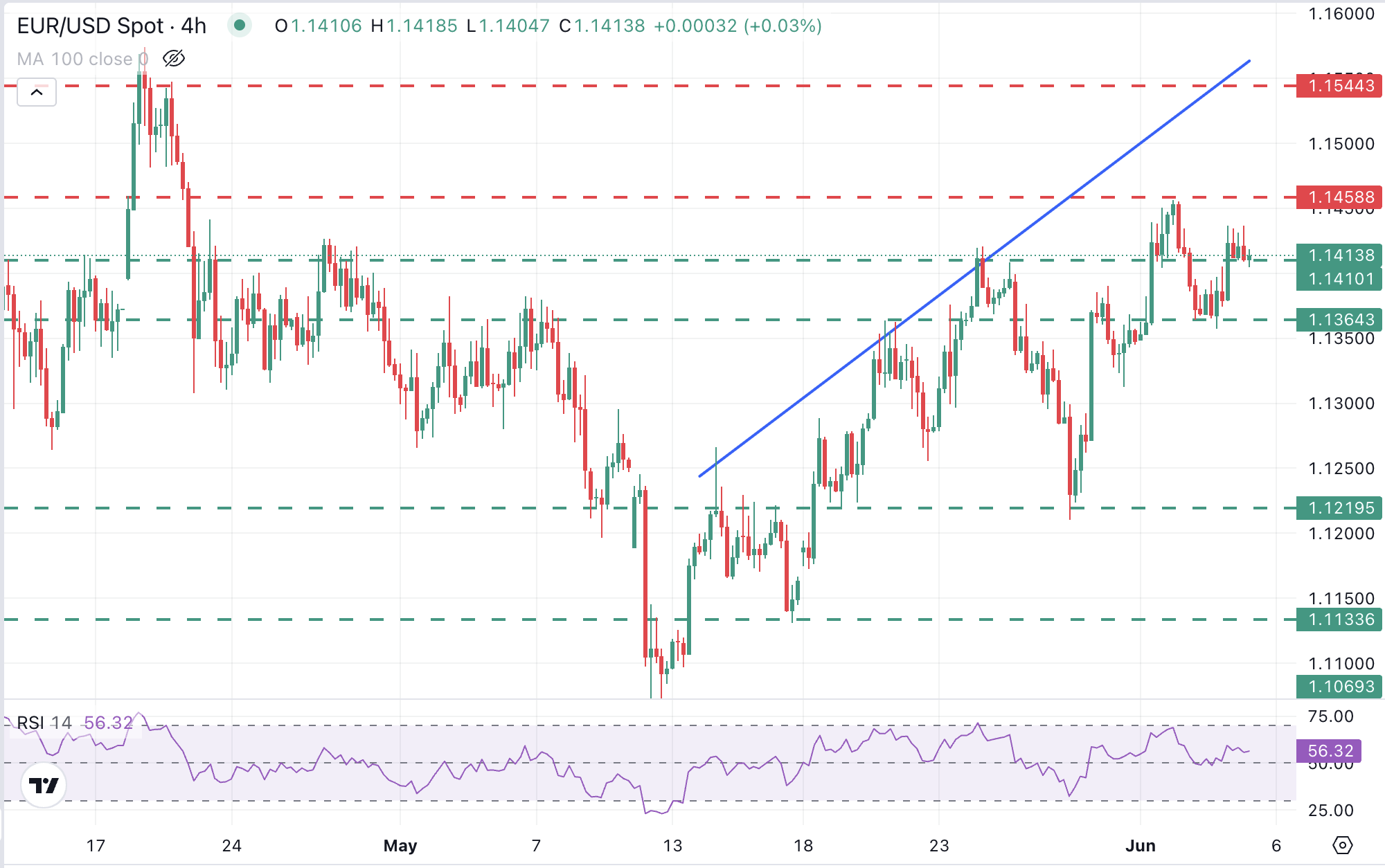
EUR/USD reversal from the six-week highs hit on Tuesday has been contained at the mid-range of the 1.1300s, but the pair has lost momentum above 1.1400 with investors looking from the sidelines, a few hours ahead of the ECB’s monetary policy decision.
The four-hour chart RSI is turning flat near the 50 level, suggesting that the pair’s bullish momentum is ebbing. The lower high on Wednesday, despite the weak US data, is a negative sign.
The pair would need to breach 1.1460 to confirm the bullish trend and aim to 1.1545, where the April 22 high and the trendline resistance meet.
Interest rates FAQs
Interest rates are charged by financial institutions on loans to borrowers and are paid as interest to savers and depositors. They are influenced by base lending rates, which are set by central banks in response to changes in the economy. Central banks normally have a mandate to ensure price stability, which in most cases means targeting a core inflation rate of around 2%.
If inflation falls below target the central bank may cut base lending rates, with a view to stimulating lending and boosting the economy. If inflation rises substantially above 2% it normally results in the central bank raising base lending rates in an attempt to lower inflation.
Higher interest rates generally help strengthen a country’s currency as they make it a more attractive place for global investors to park their money.
Higher interest rates overall weigh on the price of Gold because they increase the opportunity cost of holding Gold instead of investing in an interest-bearing asset or placing cash in the bank.
If interest rates are high that usually pushes up the price of the US Dollar (USD), and since Gold is priced in Dollars, this has the effect of lowering the price of Gold.
The Fed funds rate is the overnight rate at which US banks lend to each other. It is the oft-quoted headline rate set by the Federal Reserve at its FOMC meetings. It is set as a range, for example 4.75%-5.00%, though the upper limit (in that case 5.00%) is the quoted figure.
Market expectations for future Fed funds rate are tracked by the CME FedWatch tool, which shapes how many financial markets behave in anticipation of future Federal Reserve monetary policy decisions.
Information on these pages contains forward-looking statements that involve risks and uncertainties. Markets and instruments profiled on this page are for informational purposes only and should not in any way come across as a recommendation to buy or sell in these assets. You should do your own thorough research before making any investment decisions. FXStreet does not in any way guarantee that this information is free from mistakes, errors, or material misstatements. It also does not guarantee that this information is of a timely nature. Investing in Open Markets involves a great deal of risk, including the loss of all or a portion of your investment, as well as emotional distress. All risks, losses and costs associated with investing, including total loss of principal, are your responsibility. The views and opinions expressed in this article are those of the authors and do not necessarily reflect the official policy or position of FXStreet nor its advertisers. The author will not be held responsible for information that is found at the end of links posted on this page.
If not otherwise explicitly mentioned in the body of the article, at the time of writing, the author has no position in any stock mentioned in this article and no business relationship with any company mentioned. The author has not received compensation for writing this article, other than from FXStreet.
FXStreet and the author do not provide personalized recommendations. The author makes no representations as to the accuracy, completeness, or suitability of this information. FXStreet and the author will not be liable for any errors, omissions or any losses, injuries or damages arising from this information and its display or use. Errors and omissions excepted.
The author and FXStreet are not registered investment advisors and nothing in this article is intended to be investment advice.


