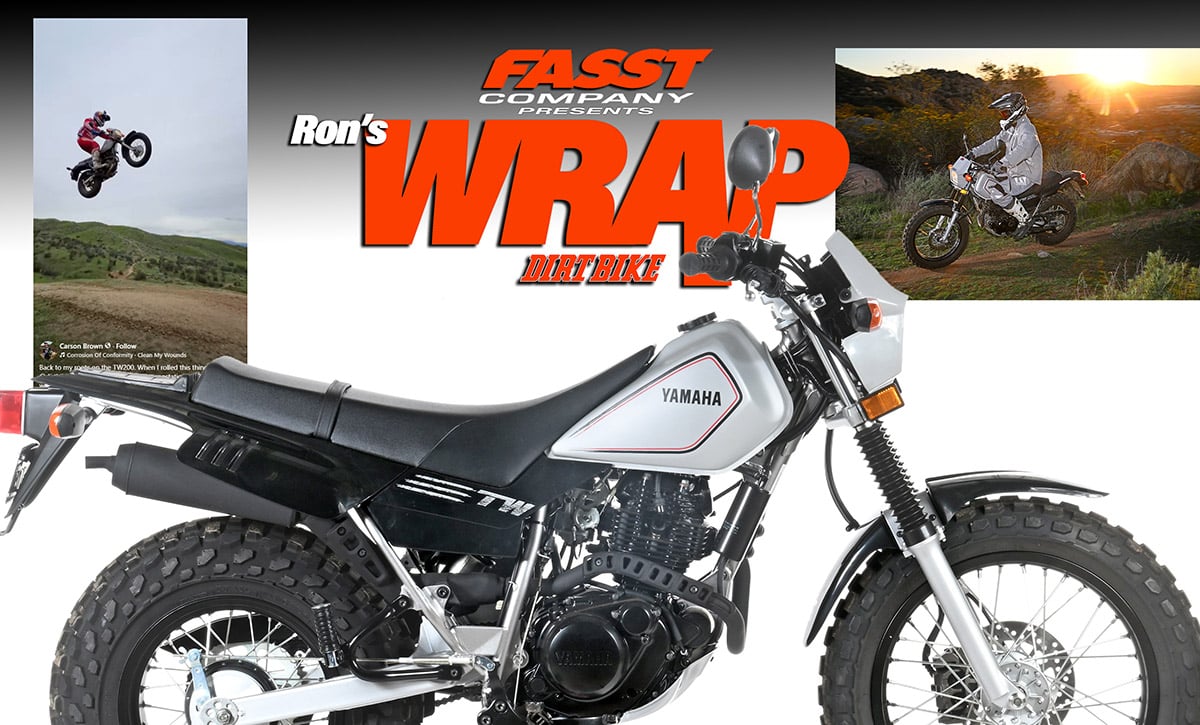
I haven’t really thought too much about the Yamaha TW200 in years. Who has? Well, my buddies Lamont Dusseau and Gary Tailor apparently had and they got a pair of them and started talking about their TW adventures every week. I thought “why not?” I asked Yamaha if I could test one. It turned out they didn’t have a TW in the loan pool, but they eventually came up with one. The TW200 is a fat-tired throwback that’s been around longer than any other dual-sport bike in the world. The “Trailway” TW200 first arrived in 1987, looking much like it does today. Side note: when I tried researching old tests of the 1987 TW200, all I came up with was a test I had written myself for Cycle World back in the day. It made me feel very old. The TW was a spin off of the dirt-only BW200 of 1985 which had even fatter tires. That first year the TW had a few issues with its ignition which prompted an update the very next year, but other than that, it went completely unchanged until 2001, when it gained a front disc brake and lost its kickstarter (a back-up only; it always had an e-start button). Fans of the Honda XR650L are quick to point out that the XR has gone completely unchanged throughout its 35-year history, and that it should rightfully hold the title of longest production run in the motorcycle world. I will let them battle it out. When cults go to war, it’s best to stay clear.

The TW’s defining elements are its tires. It has a 130/80-18 front tire and a 180/80-14 rear tire on weirdly wide spoked rims. Fat tires like that had been seen elsewhere; most famously on the Rokon two-wheel drive motorcycles of the ‘70s. The tires on the TW aren’t that wide and the rear doesn’t even use a jackshaft to get the chain to the sprocket. The engine and swingarm are just wide enough to do the job, with just a little bit of engine offset to the left. The engine itself is very old school, built after a long, hard look at the Honda XL175, circa 1973 or so. It’s an air-cooled single overhead cam two-valver with a 28mm Mikuni CV carburetor. Our test bike was a California model with a big charcoal canister on the right that was about as inconspicuous as a 2-pound nose wart. The suspension is unadjustable, the rear brake is a drum and almost all the technology was current when Nixon was president.

The TW was never meant to be on the cutting edge, and by opting out of year-to-year performance competitions, it has been immune to the pressures of advancing technology. So many other dual-sport bikes have come, grown old and gone away while the TW sat alone and unscathed; the Switzerland of dual-sport bikes. Through all that, there were some things that the TW did and still does better than anything.

First and foremost is the appeal generated by its low seat height. Those small-diameter wheels combine with about 6 inches of suspension travel to produce a seat height of 31 inches. That’s lower than anything capable of getting a license plate and a half-foot lower than a Honda XR650L. It’s also far lighter than any other Japanese dual-sport bike–267 pounds without fuel. That’s lighter than the Honda XR150L or even the brand-new Yamaha WR125R.
Those benefits come at a cost. To state the obvious, the TW is no motocross bike. It doesn’t have the power or the suspension travel to even do a lap around the average track without a frightening moment or two. The motor makes around 12 horsepower. That means that jumps are more like little hillclimbs and real hills are overwhelming. To be fair, it can climb Mt St Helens at Glen Helen, which is widely regarded as the steepest hill on any mainstream motocross course. But, it’s not easy. And if there are other bikes on the track, you might need a ramp on your back. More relevantly, the TW can keep up with highway traffic.

Actually, the list of things the TW can do is significantly longer than the list of things it can’t do. It can go over 100 miles on a tank of gas. It can fit almost anyone, regardless of size. It can fit in the trunk of a 1965 Ford Galaxie. And it can fit into the budget of a high-school senior working at Cinnabon. That last point is even more significant when you consider that the TW is still made in Japan. Other manufacturers have moved production of their “budget” dual-sport bikes to Southeast Asia. The TW has an MSRP of $4999, making it one of the most affordable motorcycles coming out of Japan.

And, the TW200 actually has some surprising capabilities that other dual-sport bikes don’t have. The fat tires give it the ability to float on soft dirt. If you put a Honda XR650L in deep sand, the only way it can keep going is with speed. Once it stops, it sinks. The TW, on the other hand, can stop and start as many times as you like. It’s a good thing, too–it doesn’t have speed in its bag of tricks. There are some peculiar handling traits, though. While the front wheel might not sink in sand, it doesn’t offer much straight-line stability. The contact patch is virtually round. You could probably use a trashcan lid instead of a tire with similar results. Also, the TW doesn’t like to slide–or at least the rear wheel doesn’t. If you go into a turn with speed, the front wheel will generally break loose first unless you have your weight way, way forward.
One aspect of TW cult membership that’s essential is the underground information network. The bike’s technology was frozen in place four decades ago, but there are solutions for everything. Can’t handle the super narrow footpegs? There are lots of alternatives. Did you bend your shift lever on a passing bush? Check in on the TW200 forum for advice. Bigger, stronger parts aren’t always the answer. If you find an unbendable shifter, you might bend your shift shaft. All the information is out there for the finding.
On another side note, Carson Brown took one look at my TW200 (that’s right, I think of some test bikes as “mine”) and snagged it. He then did unthinkable things to it, and I haven’t yet seen the results yet. I’m scared. You can read the full test in our upcoming Dual-Sport/Adventure Bike Buyer’s Guide.