

commentary
Kaiser Wilhelm II was an erratic despot known for unhinged foreign policy schemes. The result was catastrophe
Published
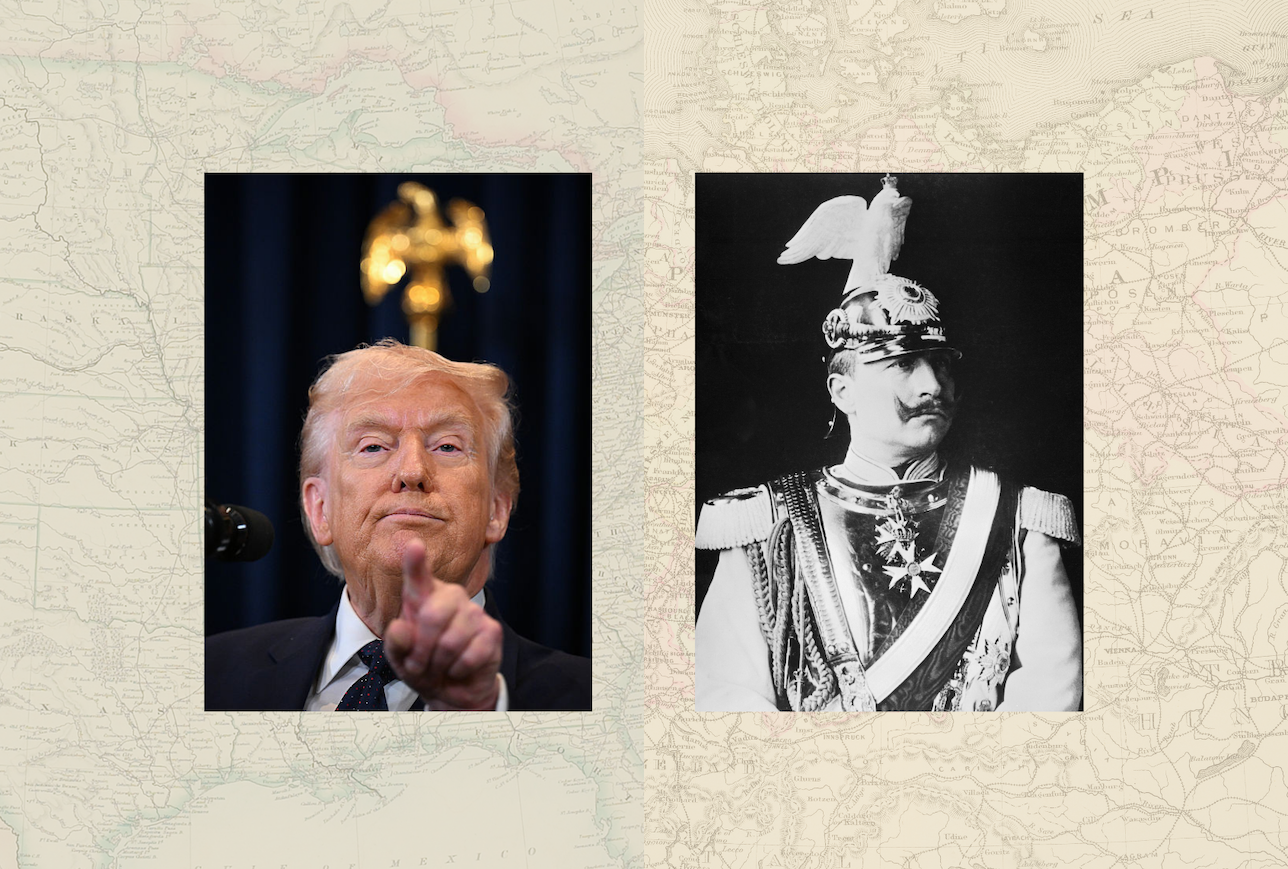
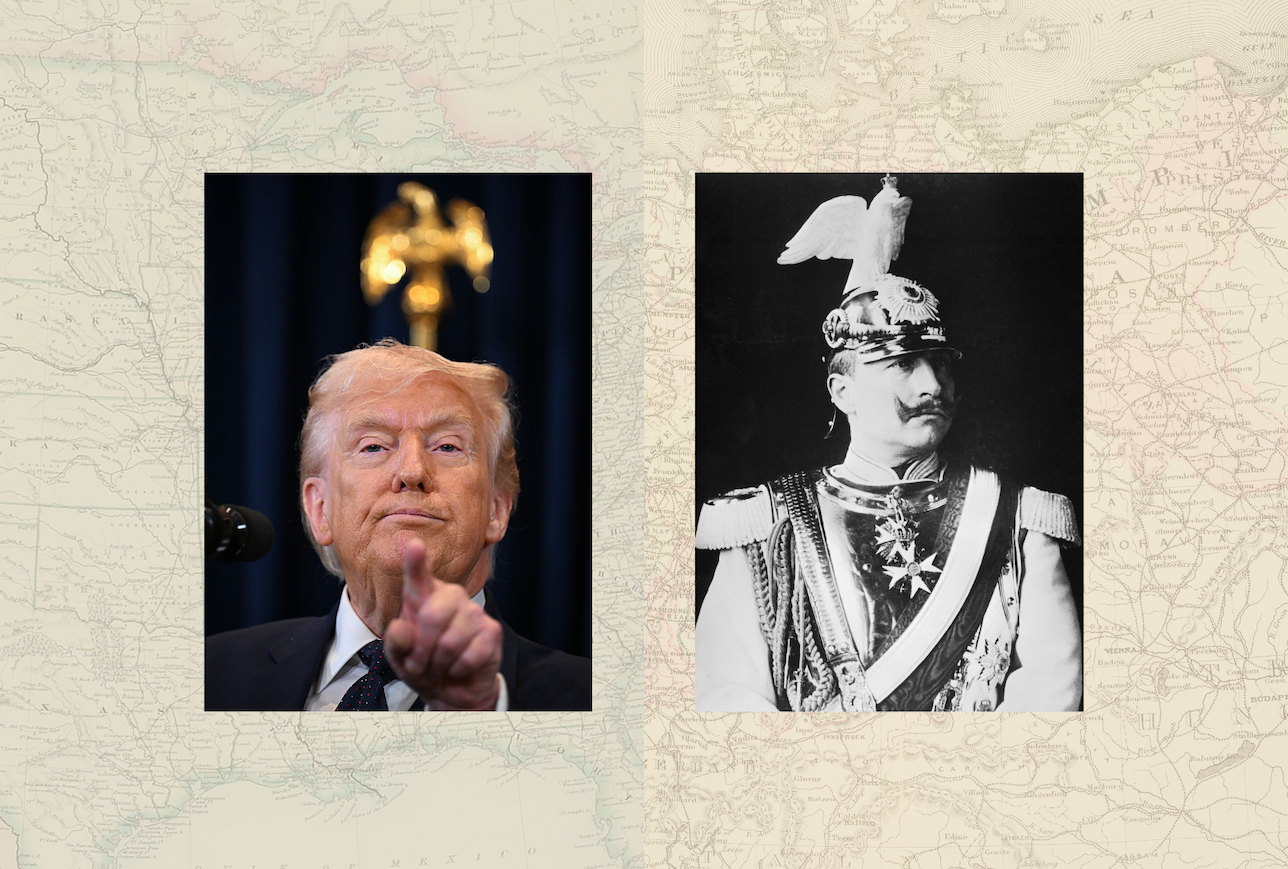
President Donald Trump and Kaiser Wilhelm II (Illustration by Getty Images/Salon)
He was a grandiose personality with a massively inflated sense of his own historical importance, given to outlandish foreign policy proposals that his advisers and underlings had to ignore or walk back or pretend to take seriously. He loved military pomp and ceremony and viewed himself as a brilliant strategist, despite a total lack of expertise or experience. His intemperate public remarks sparked international outrage, creating crises his subordinates were forced to repair. He finally walked his country into a disastrous and entirely avoidable war that destroyed his reputation and inflicted enormous worldwide damage, with devastating ripple effects that extended decades into the future. One prominent historian described his personality as
superficial, hasty, restless, unable to relax, without any deeper level of seriousness, without any desire for hard work or drive to see things through to the end, without any sense of sobriety, for balance and boundaries, or even for reality and real problems, uncontrollable and scarcely capable of learning from experience, desperate for applause and success … romantic, sentimental and theatrical, unsure and arrogant, with an immeasurably exaggerated self-confidence and desire to show off.
I mean, right? If you started this article at the top, you already know that I’m comparing a certain contemporary leader with Kaiser Wilhelm II, the last emperor of Germany and king of Prussia, who may bear more responsibility than any other single individual for the ghastly carnage of World War I. (I’m not making a definitive historical claim; there’s plenty of blame to go around among the self-involved leaders of the so-called great powers.) The similarities are striking on various levels, as well as comical and more than a little disturbing. To rework Karl Marx’s famous maxim, sometimes historical events can be tragedy and farce at the same time, and repeat themselves in the same register.
But there are also important differences between the two men that it’s important to acknowledge up top, none of which reflect well on the present-day United States, its current president or its debased public life. This is a strange thing to say about a buffoonish despot from the tail-end of Europe’s imperial age, but Wilhelm was a vastly more enlightened figure than Donald Trump. When he wasn’t busy marching around in other countries’ military uniforms (a favorite pastime), he was something of a populist reformer, or at least he wanted to be. Amid the bewildering forest of his unpredictable and contradictory opinions (ahem!), Wilhelm supported full rights for labor unions and the creation of a cradle-to-grave welfare state, hoping that such things might keep the unstable German Empire (aka the Second Reich) afloat.
It would be going too far to suggest that Wilhelm was not overtly racist — for a person of his class and background in the late 19th century, that would have been virtually impossible — but his constantly reinvented and fantastical worldview sometimes produced surprises. During a visit to the Ottoman Empire he declared his undying friendship with the world’s “Mohammedans” (i.e., Muslims), although that issue had little political relevance at the time. Wilhelm became infamous for lecturing other European leaders about the “yellow peril” they might face in an alliance between China and Imperial Japan (who were actually bitter enemies at the time), but Cambridge historian Christopher Clark suggests that it’s not fair to pin him down that way, since at other moments Wilhelm argued that Germany should ally itself with either China or Japan, as well as the U.S., against Britain, France and Russia. Whatever position he held on Tuesday, he was likely to hold the opposite on Wednesday, which does sound a bit familiar.
This is a strange thing to say about a buffoonish despot from the tail-end of Europe’s imperial age, but Kaiser Wilhelm II was a vastly more enlightened figure than Donald Trump.
As we say these days, perhaps you see what I did there: Two paragraphs intended to illustrate the differences between Wilhelm II and Donald Trump, but that end up make them sound more alike. There’s no doubt that Trump entered public life by presenting himself as a champion of the “forgotten American,” a reformer or revolutionary who would sweep away the bureaucracies of government and both political parties and renew the nation’s lost greatness by solving all kinds of intractable problems that defeated conventional politicians. He probably believed it, as much as he has ever believed in anything, because he has (or had) limitless faith in the power of his personality and in his ability to reshape reality. (I suspect Trump also used to believe that he wasn’t a racist, although that has gotten confused by the degraded condition of “conservative” politics, in which outright racism is now cool.)
Wilhelm professed the same kind of grandiose and delusional self-confidence, writing in a letter to the Prince of Wales and future king of England — who was his uncle, by the way, since all the royal houses of Europe were closely related — “I am the sole master of German policy, and my country must follow me wherever I go.” But here’s the thing: That was definitely not true. The German Empire, which had only existed for 17 years when Wilhelm took the throne in 1888, was a half-baked constitutional monarchy. While the kaiser could appoint or dismiss government ministers and was “consulted” on important matters, he had little or no control over the daily affairs of state. If he floated an absurd or dangerous idea — seizing Greenland from the Danes, just for instance — his ministers were largely free to roll their eyes, assign a junior flunky to write a memo on the subject, and get back to work.
As far as I can tell, Wilhelm never proposed an invasion of Greenland; that might have struck him as thinking too small. According to Clark’s exhaustive study of the prewar years, “The Sleepwalkers” (which frequently cites J.C.G. Röhl’s German-language Wilhelm biography), the kaiser was more interested in Latin America, at one point in the 1890s proposing a “Neudeutschland” or German colony in Brazil, and a few years later instructing his admirals to draft plans for invading Cuba, Puerto Rico and — perhaps in a burst of Teutonic WTF — also New York. By 1908, Wilhelm’s attitude toward the U.S. was more benevolent, and he offered President Theodore Roosevelt an elite corps of Prussian soldiers to be posted in California, supposedly to fend off a Japanese invasion. (Roosevelt declined.)
Trump’s first-term brainstorm about setting off nuclear bombs inside a hurricane might well have appealed to Wilhelm, at least if nuclear weapons had existed and if tropical storms were ever an issue in northern Europe. Perhaps the point here is that both of these overconfident and ill-informed men were thoroughly convinced of their own brilliance, on a level well above the ordinary mortals around them, but that one of them — at least for most of his career — posed no serious threat to the world order. Germany’s imperial navy was not going to attack New York under any imaginable circumstances, and Wilhelm’s insistence on colonizing Brazil (or, on another occasion, “Mesopotamia”) came to “absolutely nothing,” as Clark puts it.
Wilhelm never proposed an invasion of Greenland. He was more interested in Latin America, at one point proposing a German colony in Brazil, and a few years later instructing his admirals to draft plans for invading Cuba, Puerto Rico and — in a burst of Teutonic WTF — even New York.
Yet again, however, the dissimilar qualities start to feel like echoes. If Wilhelm’s appointed ministers learned how to ignore and deflect his relentless flow of bad ideas, didn’t much the same thing happen during the first Trump presidency? Wilhelm held the imperial throne for 30 years, outlasting any number of chancellors and foreign ministers, and over that time grew craftier about how to wield influence by appointing men who would indulge his less ludicrous impulses. I hardly need to observe that everything about America’s desperate condition in 2026, up to and including the impulsive and self-destructive war on Iran, results from Trump’s return to power unleashed by the courts, unconstrained by normal politics and surrounded by shameless sycophants.
Historians disagree on exactly how much power over the German state Wilhelm had consolidated by the early 20th century, as well as how much Germany’s massive naval buildup — the kaiser’s pet project, which was inevitably understood by the British as a threat — contributed to the outbreak of the most godawful and certainly most pointless war in human history. (Clark argues that Wilhelm was more of an irritant than a decisive factor.) But it’s not controversial to say that Wilhelm’s big mouth had a tendency to make things worse. He caused major international scandals more than once, most notably after a 1908 article in the Daily Telegraph that quoted him calling the English “mad as March hares” and flinging random insults at the French, Russians and Japanese.
Want more sharp takes on politics? Sign up for our free newsletter, Standing Room Only by Amanda Marcotte, also a weekly show on YouTube or wherever you get your podcasts.
To belabor the obvious one more time, Donald Trump has said worse things than that in virtually every week of his decade in public life. If nothing he has done, at least so far, is likely to rival the outbreak of World War I, that’s the result of chance and circumstance more than anything else. History never renders a final verdict, but it’s hard to resist the deeply ironic conclusion that imperial Germany during Wilhelm’s reign was closer to being a functional democratic state than the United States is right now. On the related but perhaps irrelevant question of individual character, the evidence is clear: Wilhelm II was an unstable and vainglorious idiot who wound up in the wrong place at the wrong time. For whatever it’s worth, he seems like a nicer person than the one we’ve got now, but that’s a pretty low bar.
Related Topics
——————————————
Related Articles


