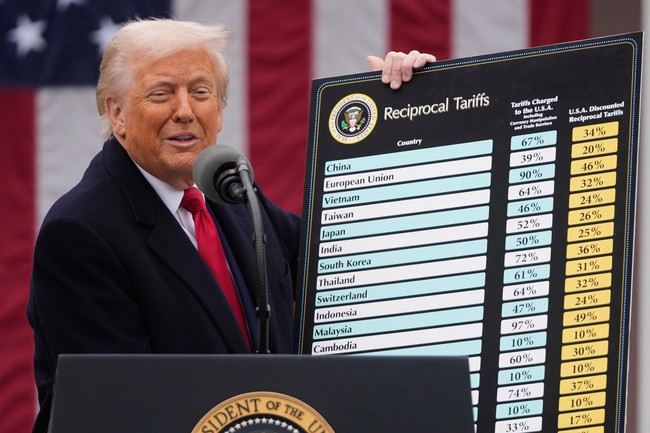
Many Americans understandably looked at Thursday’s tariff ruling by the Court of International Trade (CIT) and had the same reaction: Wait — didn’t the Supreme Court already strike down one set of Trump tariffs earlier this year? And now another court is blocking another set?
The short answer is yes — but these are actually different tariffs imposed under different statutes, and understanding the distinction matters because the real issue here isn’t simply trade policy. It’s about how much unilateral economic power Congress has delegated to the president — and how narrowly courts are willing to read those delegations.
While many of the Supreme Court decisions handed down since Donald Trump reclaimed the presidency have inured to the favor of his administration, not all of them have. One of the most striking and consequential rulings that didn’t go the way of the administration was the Court’s tariff decision, handed down in February. That decision, in a nutshell, held that the International Emergency Economic Powers Act (IEEPA) did not authorize the president to impose certain tariffs.
But IEEPA isn’t the only mechanism via which the administration has imposed tariffs. The administration, via Proclamation 11012, also imposed some tariffs pursuant to Section 122 of the Trade Act of 1974, and these tariffs, rather than being based on a “national emergency,” were aimed at large and serious balance-of-payments deficits — essentially, major international payment/trade imbalances.
Titled “Balance-of-Payments Authority,” Section 122 empowers the President of the United States to impose temporary surcharges up to 15 percent ad valorem when fundamental international payment problems exist.
Naturally, these tariffs were challenged in court as well. In March of 2026, multiple states filed suit against the administration challenging the Section 122 tariffs, as did Burlap and Barrell and Basic Fun Inc. (the importer plaintiffs). Both lawsuits were filed in the CIT, which, in a 2-1 decision on Thursday, entered judgment in favor of the importer plaintiffs and the state of Washington and permanently enjoined Proclamation 11012, declaring it “invalid as contrary to law.” (The court dismissed the claims of the other state plaintiffs without prejudice on the basis of standing.)
RELATED: Breaking: Supreme Court Says No to Tariffs by Emergency Decree
The key to the court’s ruling here isn’t that tariffs are bad (or good) or that the executive has no authority to impose them. It’s that, in this instance, the administration went beyond the authority delegated by Congress via the statute in question. I recognize that may be somewhat frustrating, but the heart of the issue, honestly, is that, per the Constitution, the power to levy tariffs rests with Congress, not the president. And while Congress has enacted several laws delegating some of that authority to the president, the courts increasingly appear inclined to construe those delegations narrowly, particularly where major economic powers are concerned.
On Friday, the administration filed a notice of appeal as to the CIT’s decision, so this fight is far from over. The case now heads to the Federal Circuit and could ultimately wind up before the Supreme Court yet again. In the meantime, the administration will almost certainly seek to keep the tariffs in place while the appeal proceeds.
Notably, even the dissenting judge in Thursday’s ruling did not fully embrace the administration’s position on the merits. Instead, Judge Timothy Stanceu argued primarily that the majority moved too quickly procedurally by resolving the case on legal theories the parties had not fully briefed. In other words, the dissent’s strongest point was less “these tariffs are clearly lawful” and more “this case should not have been decided this way.”
Which may point to the biggest takeaway from this growing line of tariff cases: The courts are not necessarily saying presidents lack tariff authority altogether. Rather, they appear increasingly skeptical of expansive readings of decades-old statutes that allow the executive branch to exercise sweeping economic power absent clear and specific congressional authorization. In other words, if Congress wants presidents to possess broader unilateral tariff authority, courts are signaling with increasing intensity that Congress itself needs to say so.
Editor’s Note: Unelected federal judges are hijacking President Trump’s agenda and insulting the will of the people.
Help us expose out-of-control judges dead set on halting President Trump’s mandate for change. Join RedState VIP and use promo code FIGHT to receive 60% off your membership.