European and African business leaders and heads of state have announced a raft of clean energy and infrastructure investments at the recent Africa Forward Summit in Nairobi. Forty companies announced plans to invest roughly 27 billion euros ($31.5 billion) across about 30 projects in Africa. They aim to generate a combined 100 billion euros ($116.5 billion) in revenue while employing more than 600,000 people across the continent.
The wider goal is to deepen industrial ties and accelerate Africa’s transition to low-carbon power. Energy attracted the largest share of investments, roughly 14 billion euros ($16.3 billion). Agriculture, human capital, finance, AI, industrialization and the blue economy were also a focus.
Kenya and France jointly hosted the May 11-12 gathering, which organizers said was designed to build a “partnership of equals.” Africa and Europe, particularly France, have historically had a contentious relationship rooted in colonialism.
Commitments on renewable energy
French utility EDF confirmed plans for 2 gigawatts of hydropower projects across several African countries. French oil and gas major TotalEnergies outlined more than $10 billion in new investments by 2030, including $2 billion for renewable power in Rwanda and $400 million for clean cooking initiatives in Kenya, Uganda and Tanzania. TotalEnergies will also work with Ellipse Projects on the construction and renovation of hospital infrastructure worth $700 million.

Infrastructure investor Meridiam announced $200 million to double the capacity of Kenya’s Kipeto wind project, while Global Telecom Holding pledged $350 million for a 250-megawatt solar farm in Zambia.
AXIAN Group and partners committed $280 million to co-develop digital and energy infrastructure, while Schneider Electric pledged $20 million to its GAIA Energy Impact Fund II, which invests in African clean-tech startups.

Shipping line CMA CGM joined African stakeholders in a $700 million port upgrade in Mombasa, Kenya, to accommodate next-generation container ships using energy-saving smart port systems.

The deals also extend beyond energy generation to transmission and access with plans for modular bridge plants in three countries and a $1.7 billion pipeline network in Côte d’Ivoire.
French development bank Bpifrance and Morocco’s OCP Group launched the Seed of Africa Investment Fund with $150 million to back sustainable agro-industrial ventures, including fertilizer innovation and renewable-powered production lines.
Leading the global energy transition?
African leaders have argued the continent should play a leading role in the global energy transition, given its vast renewable energy potential. Speaking at the summit, Kenyan President William Ruto said: “For Africa, this energy transition must also be an industrial transition.”

Observers say the deals announced in Nairobi could be a path toward low-carbon energy access for more than 600 million people living without reliable electricity in Africa.

A final outcome document obtained by Mongabay calls for further commitments to promote green industrialization through investments in renewable energy and low-carbon systems including hydrogen, hydropower, geothermal, waste-to-energy and nuclear power.
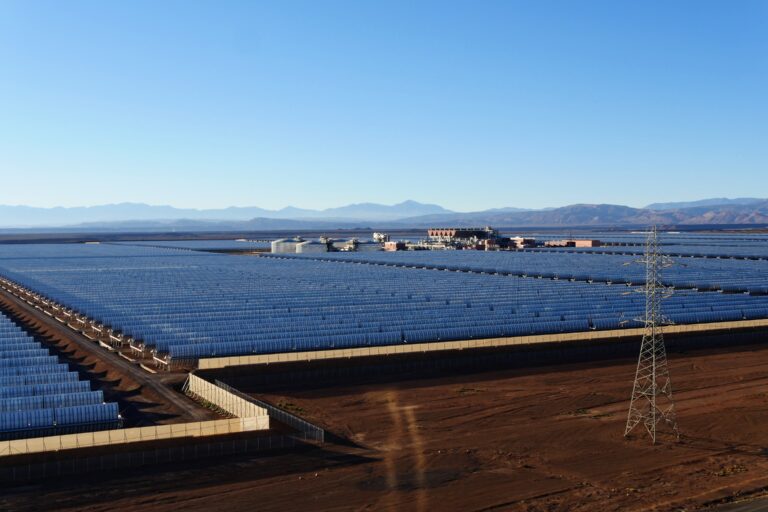
Banner image: Solar panels at the NOOR solar complex in Ouarzazate, Morocco, one of Africa’s largest renewable energy projects. Image courtesy of AfDB.

Credits