
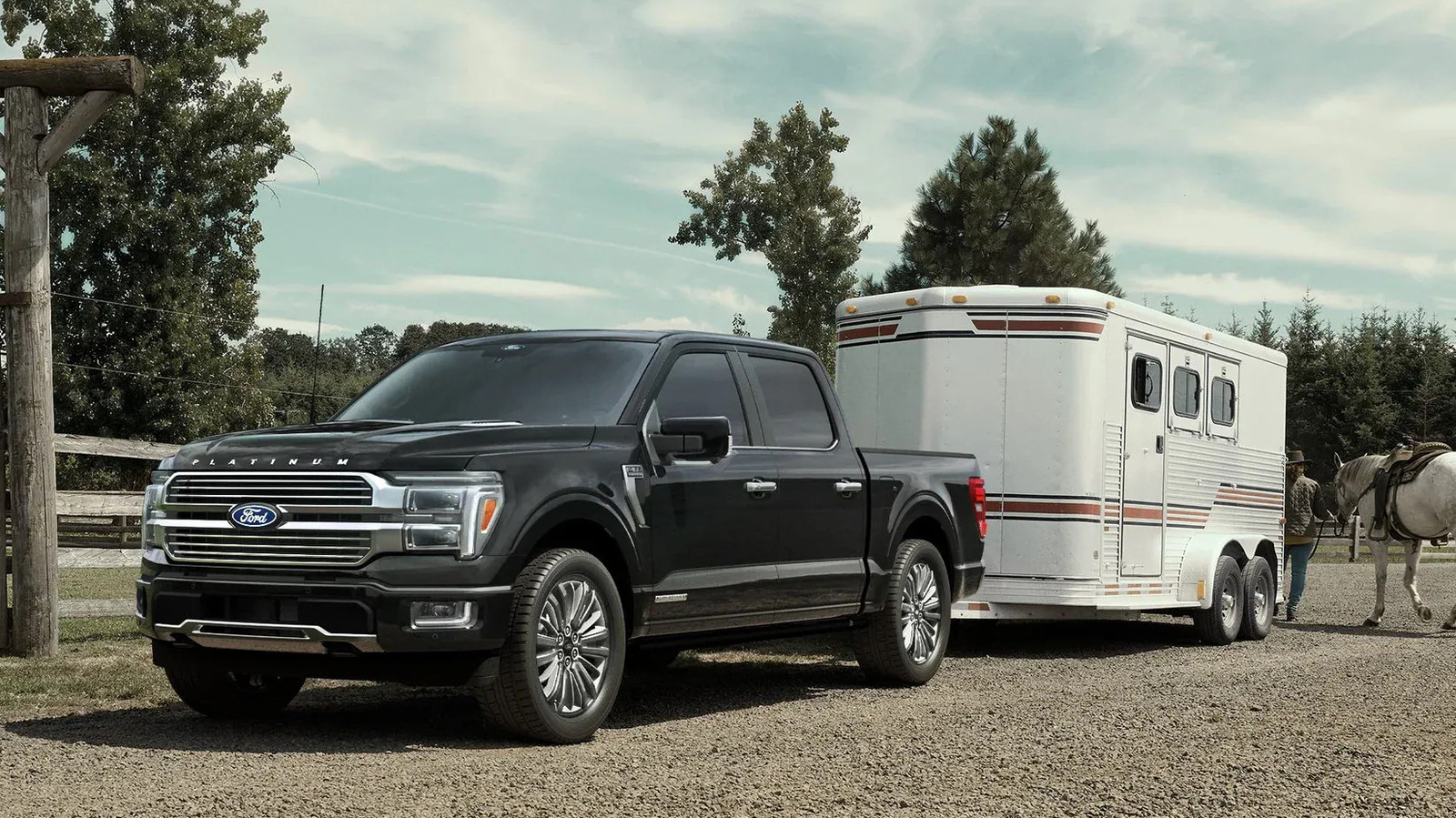
The common Ford F-150 isn’t what most people picture when someone mentions the word “fast.” Okay, granted, the Raptor and its many derivatives exist, such as the ludicrously powerful Raptor R boasting 900 horsepower. Let’s forget about all that, though — what about just the regular old F-150? Well, unsurprisingly, they are actually quite powerful as well, as many full-size trucks are these days, but normally we associate all that power with hauling cargo and towing. Not really on the drag strip.
We are not extolling the virtues of an F-150 at a drag strip — any modern purpose-built vehicle with similar power figures will blow the doors off one. These trucks are massive, packed with technology and features that acts as ballast to slow them down. However, the top-of-the-line hybrid model also boasts a combined 430 hp, plus it has that 4WD launch and a more modern chassis. That’s good enough to launch it a quarter mile in a respectable 13.5 seconds at 102 mph, according to a test conducted by Car and Driver. 13.5 seconds? That’s an easy target for most classic muscle cars, right?
Let’s rewind to the heyday of the drag strip: The Golden Years of the Muscle Era. We’re talking late-1960s, early-1970s, when passenger cars were pumping 400 horses or more. Sure, plenty of them can — and will — smoke a modern F-150 all day long, but an equal number of them get left behind, some being embarrassed by well over a second. Let’s take a look at some examples of the latter, particularly cars that are famous for their prowess on drag strips.
Pontiac GTO Ram Air IV
Madeline Cuccio / SlashGear
A quick disclaimer about the pass times — different magazines and journals generally post different times. Whether it’s due to shifting style or environmental conditions, the results are largely inconsistent, so we’re considering the best-case scenario here. However, that also opens up the door to other runs made a full second or so down, generally because of differing gear ratios or transmission types, as is the case here. Despite its immense reputation, the second-gen Ram Air IV GTO is, at best, a mid-13s car, if not a mid-14s car with a longer final drive. There’s actually quite a few muscle cars that make the GTO look slow.
Indeed, that is the case here as well, with the car running anywhere between a 13.6 and a 14.47 depending on who you ask and what options it has. This means that, at best, a bone-stock GTO in its heyday is almost exactly as fast down the drag strip as a modern F-150 hybrid. But how could that be?
First of all, let’s look at the physics. Acceleration is determined by force over mass, the fundamental equation we all know and love. An F-150 has a lot of mass, but so too does a GTO; a regular Judge weighs over 3,600 pounds. Next is power, and the GTO has far less. 370 break horsepower, not SAE Net horsepower, which is how we measure it today. That means it has 370 unladen horsepower at the crank, versus the F-150’s 430 horsepower at the wheels. This is a common theme among every one of these cars, and a key reason why modern cars seem so much faster, despite having similar on-paper statistics.
Ford Mustang Boss 429
Heritage Images/Getty Images
Absolutely no car enthusiast worth their salt would ever accuse a Boss 429 of being slow. These were purpose-built race engines, after all, highly specialized for the demands of NASCAR. In a world where your competition was the Dodge Charger Daytona, you had to bring something truly special to compete, which is exactly what Larry Shinoda did in 1969 with the baddest showroom Mustang ever built up to that point. The engine has a ton of interesting tidbits as well. And, appropriately-so, given its nature as a detuned NASCAR engine, the Boss 429 was indeed the most powerful Mustang out there. It is also slower than a modern F-150 hybrid.

That “slower” comes with a huge asterisk, granted. Yes, this is an incredibly potent vehicle, but it was not designed for drag racing. It is effectively a homologation special, a street-legal car produced to legitimize the stock car racing variant. In a phrase, this car exists as it is because Shinoda wanted an incredible race car, and it was absolutely a fine racer. But take note of that trap speed — 114 mph shows plenty of promise in the latter half of the stage, where the engine can really sing.
Whether it’s due to the old tires of the day, improper axle ratios, or just bad luck, you’ll find stock Boss 429 reports in the high-13 second range. These were exquisitely powerful top-end focused cars, not dragsters, despite the fact that they could easily hang with anything else on the drag strip in 1969.

Hurst/Olds 442
Madeline Cuccio / SlashGear
When people think of Hurst shifters, they think of drag racing. The company heavily sponsored the sport, after all, even outfitting show cars like the Hurst Hemi Under Glass Barracuda, the Hurst Hemi Super Stocks, and more. George Hurst and his traveling engineer Jack “Doc” Watson, better known as the “Shifty Doctor,” were instrumental in popularizing the image of a floor-shift 4-speed flying down the drag strip. And central to that image, at least in automotive showrooms, was the Hurst/Olds 442. Yes, the 4-4-2 actually has a meaning.
The Hurst/Olds was the brainchild of Doc Watson, built specifically with that clientele in-mind. Amateur drag racers rejoiced at the 390 horsepower and 500 lb-ft of torque delivered by the beefy 455 big block, propelling the A-body to the 1/4 mile mark in around 13.9 seconds, though some claim just over 14 seconds. In other words, this heavily-marketed drag special is a full half-second off the pace of an F-150 hybrid.
Granted, as far as drag specials go, the Hurst/Olds is a pretty tame one. These were fully-equipped cars, after all. Actual purpose-built dragsters built by Hurst, namely the Hurst Hemis, would absolutely blow an F-150’s doors off, but those were compact cars with specially-prepared body panels and put on extreme diets, whereas the Hurst/Olds is as big as any modern midsize sedan. That said, it’s certainly not a slow car, either, especially for its day and general class; these were some of the torquiest muscle cars of all time, and that torque carried it a long way.
Plymouth Barracuda 440

If intermediate muscle cars aren’t cutting it, what about a potent pony car? The Barracuda is a lightweight, stylish, and intimidating beast in Formula S trim, with most examples boasting a 383 ci (6.2-liter) V8 with 330 hp and 410 lb-ft torque from a fairly small body. If you ever see a late-1960s Barracuda in person, they’re quite narrow and almost diminutive in comparison to something like a B-body Charger. Granted, they’re far less powerful, but they’re also far lighter. How does that translate to the drag strip, though?
About the same, as it turns out. Okay, let’s discount the E-body Hemi ‘Cuda and its Challenger sibling because it’s no surprise that shoving an overpowered 426 Hemi in something so compact will turn it into a missile on wheels. This is specifically about the pre-Hemi model, the one where the top engine choices were the 383 or the 440. The 383 is out of the running already, crossing the line about a second slower than an F-150. The 440 fared better, as one might expect — granted, it’s not the Six-Pack, just a four-barrel, but it’s enough to clock an impressive 13.89 seconds from the Barracuda.

The caveat here is there isn’t much official data available on these cars; to be fair, 440 Barracudas themselves are scarce cars as well, but 1960s Chrysler certainly wasn’t shy at the drag strip, and the company demonstrated it with this car — a lightweight body with a massive engine. Pure muscle in every sense, yet it is still somehow slower than a regular F-150 hybrid.
AMC Javelin AMX 401
Madeline Cuccio / SlashGear
Much like Chrysler, AMC was heavily invested in motorsports, drag racing included. Sure, the defunct automaker is most famous for its SCCA races with the red, white, and blue livery on the Javelin, but these things saw plenty of drag strips as well, especially the massively-underappreciated AMX. Some were even outfitted by Hurst as specialty vehicles, much like the Hurst Hemis, built as direct competitors to those very cars in 1969. Naturally, the Hurst Lightweight AMX, as it was called, was no ordinary AMX, teasing 10-second territory in 1969. The company’s most powerful road car sadly a bit underwhelming by comparison.

AMC’s most formidable offering of any sort was the 401 cubic inch-equipped Javelin AMX, a 3,400-lb pony car that was on equal footing with cars well above its weight. These cars boasted 335 hp and 435 lb-ft torque, propelling them to a 14.3-second quarter-mile. In other words, the best AMC has to offer is a solid bus length behind the F-150 hybrid when it crosses the finish line.
That would be missing the point of this particular car, however. Like the Barracuda, the AMX was built from the ground up as a pony car. It primarily competed on the circuit, not the drag strip. These were certainly lightweight and powerful cars, but they were designed to be agile, not brutally fast-accelerating.
All that said, a modern F-150 hybrid holds a number of advantages over the AMX and, indeed, any car on this list. None of these cars are 4WD, they’re all running on 1960s and 1970s tires, they have four-speed manual or three-speed automatic transmissions, and so on. However, considering what they’re working with, even a 14.3-second time is impressive when put into context.


