
Final roster cuts are less than a week away. On Sunday, August 30, teams must reduce their rosters in one fell swoop from the current 90 players to a maximum of 53.
But getting down to 53 doesn’t mean roster-building stops.
In fact, the period immediately before and after final cuts can be one of the more interesting parts of the NFL calendar for teams looking to improve their roster. Players who appeared to have no path to a roster spot suddenly become available, teams with a surplus at one position may be willing to deal from that depth, and late-round draft picks can become useful currency.
Final cuts create a temporary trade market. Dallas can buy, sell, or swap—and the roster has enough needs, surplus, and draft capital to make all three worth exploring.
The Cowboys have certainly been willing to participate in that market since Will McClay took over as the team’s VP of player personnel in 2013.
| Year | Cowboys activity around final cuts |
| 2013 | Acquired LB Edgar Jones after final cuts; traded Sean Lissemore and Dante Rosario for seventh-round picks |
| 2014 | Acquired DE Lavar Edwards for a conditional seventh-round pick |
| 2015 | Acquired RB Christine Michael for a conditional seventh-round pick; later traded for WR Brice Butler |
| 2016 | Passed on Mark Sanchez trade, signed him after release |
| 2017 | Acquired CB Bene’ Benwikere and LB Jayrone Elliott for conditional late-round picks |
| 2018 | Acquired OG Parker Ehinger from Kansas City in exchange for CB Charvarius Ward |
| 2019–2022 | No notable activity around final roster cuts |
| 2023 | Acquired Trey Lance for a fourth-round pick three days before final cuts |
| 2024 | No significant activity around final roster cuts |
| 2025 | Traded Micah Parsons for Kenny Clark and two first-round picks two days after final cuts |
The Cowboys’ track record shows that they are familiar with using this part of the calendar to make roster adjustments, even if they haven’t done so every year. And, as the Charvarius Ward-for-Parker Ehinger trade painfully demonstrated, these deals can sometimes look very different in hindsight.
But there may be an important difference between the Cowboys of a few years ago and the team we see today.
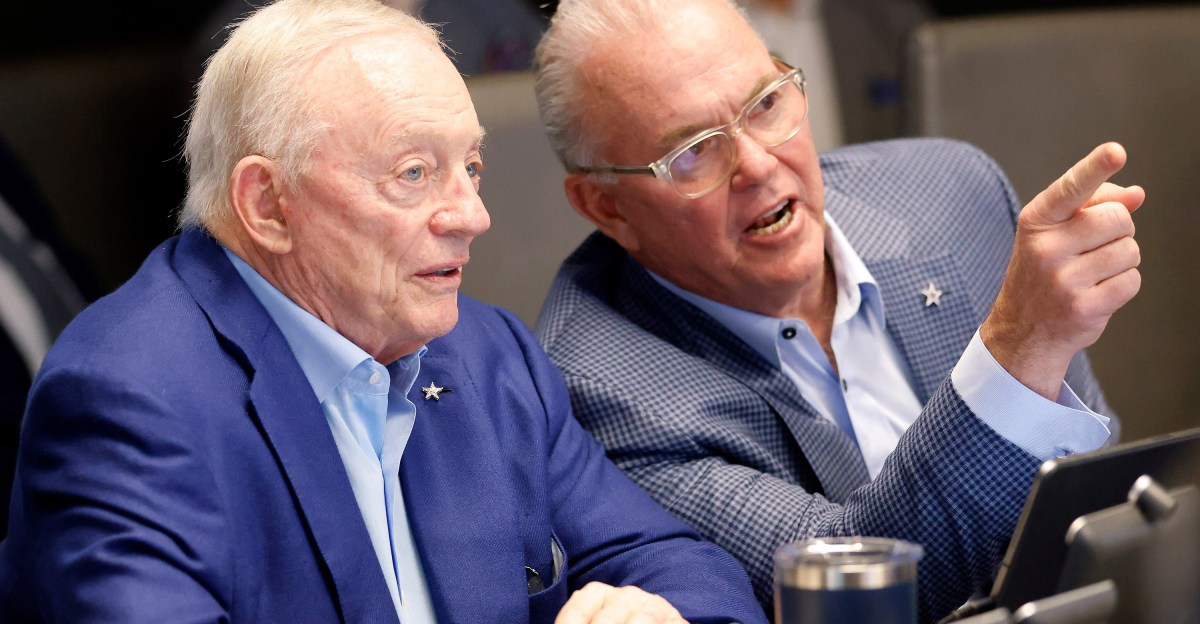
Just a week ago, Jerry Jones hinted that the Cowboys are not done making roster moves and remain open to trading future draft capital for a “substantive” defensive player, even following the addition of Von Miller.
Head coach Brian Schottenheimer echoed that sentiment, saying, “We’re not done potentially adding pieces” when discussing the continued construction of the roster.

The Cowboys now appear to have more than one approach to the trade market.
Two ways to add players
The simplest way to look at the Cowboys’ potential trade activity is to separate it into two very different types of moves the Cowboys have recently embraced.
| Adding substantive players | Plugging roster holes | |
| Objective | Materially improve the roster | Address a specific weakness or depth issue |
| Expected cost | Significant draft capital | Late-round pick or player swap |
| Expectation | Immediate contributor or impact player | Useful depth and a defined role |
| Recent examples | George Pickens (3rd), Trey Lance (4th), Quinnen Williams (1st & 2nd), Kenny Clark (via Micah Parsons trade), Rashan Gary (4th) | Brandin Cooks (5th), Joe Milton (5th), Jonathan Mingo (4th), Dee Winters (5th) |
The first category is about improving the roster.
The Cowboys appear increasingly willing to use meaningful draft capital to acquire established players. After years of largely treating draft picks as something to accumulate and protect, the organization has become considerably more aggressive.

The Trey Lance and George Pickens trades were early signs of that willingness to take a swing, and the Cowboys subsequently went even bigger by acquiring Quinnen Williams for a first- and second-round pick at the trade deadline. They continued that approach into 2026, adding Rashan Gary for a fourth-round pick while also trading away Osa Odighizuwa for a third.
Those are not the types of moves teams make simply to find somebody who can survive a few snaps in September. They are attempts to materially change the roster.

The second category is about completing the roster.
This is the type of trade the Cowboys have historically used to round out their roster. A team identifies a problem area, finds another team with more players than it can keep at that position, and gives up a late-round pick or fringe roster player for somebody who can immediately fill a role.
Expecting a world-beater from those trades isn’t realistic. That’s not the point. The goal is to find a better option than the one currently sitting at the bottom of your depth chart.
Late-round picks are currency, too
Dallas currently holds two sixth-round picks and a seventh-round pick in the 2027 draft, plus all of its original picks in 2028. Those picks have value. But that value comes with a fairly obvious limitation: the odds of finding a long-term contributor that late in the draft aren’t particularly high.
Since 2013, the Cowboys have drafted 40 players in the sixth and seventh rounds. Only three of those players — Xavier Woods, Anthony Brown, and Donovan Wilson — developed into multi-year starters for Dallas. Ryan Flournoy could eventually add his name to that list, but he obviously isn’t there yet.
That doesn’t mean late-round picks are worthless. But it does mean they can sometimes be more valuable as trade currency than as lottery tickets. If another team has a proven veteran who is about to lose a roster spot because of a numbers crunch, a sixth- or seventh-round pick could be enough to get a deal done.
One intriguing example is already sitting in Pittsburgh, where OL Brock Hoffman is openly being discussed as a trade piece. Could a trade get him back to Dallas? For the Cowboys, that could represent a better return on that draft capital than hoping to beat the draft odds a year or two from now.
There’s also been chatter about the Cowboys’ potential interest in veteran CB Adoree Jackson. The Cowboys have three potential starters at CB in Daron Bland, Shavon Revel, and Cobie Durant, but should one of them miss time, the lack of quality veteran depth behind the top three may make Jackson or a similar player an interesting move for the Cowboys.
The Cowboys don’t need every trade to produce a Pro Bowler. Sometimes getting a competent veteran who can play meaningful snaps at a position of need is enough.

Selling, not just buying
The Cowboys don’t have to limit this exercise to buying players. They can also use the market to optimize the bottom of their roster. The trade market obviously works both ways. The Cowboys could be looking to add players, but they may also have an opportunity to turn some of their own roster surplus into future draft capital or player-for-player swaps.
Dallas appears to have more numbers than roster spots at wide receiver, tight end, edge rusher, and safety. Not every player who misses the final 53 will necessarily clear waivers, and some teams may prefer to give up a late-round pick rather than wait for a player they like to hit the market.
That gives the Cowboys another option beyond simply cutting players and hoping they make it back to the practice squad. If there is no clear path to playing time in Dallas, why not see whether another team is willing to pay for that player?
The addition of Von Miller to the edge rusher group creates a bit of a crunch at the position. Even if the Cowboys were to go six deep at the position, four pass rushers would be competing for the last two spots: James Houston (former 6th-round pick), Sam Williams (2nd), Marist Liufau (3rd), and Isaiah Land (UDFA). Perhaps one of the four might make an interesting trade chip if Dallas is looking to turn some of its edge rusher surplus into draft capital.

The phones should be busy
The Cowboys will definitely have an eye on offensive line depth. They remain open to additional upgrades along the defensive line, and could also have an interest in adding proven veterans at linebacker or cornerback.
At the same time, they have potential surplus players at several positions who could be turned into future assets. That gives Dallas several ways to improve the roster over the next week.
The Cowboys could make a substantive addition if the right player becomes available. They could make a smaller move to plug a roster hole. They could use a late-round pick to acquire a veteran who is more likely to contribute than a future sixth- or seventh-round selection. Or they could turn one of their own surplus players into future draft capital.
The 53-man roster may be almost set. The trade work isn’t.
Work those phones, Stephen Jones!


