
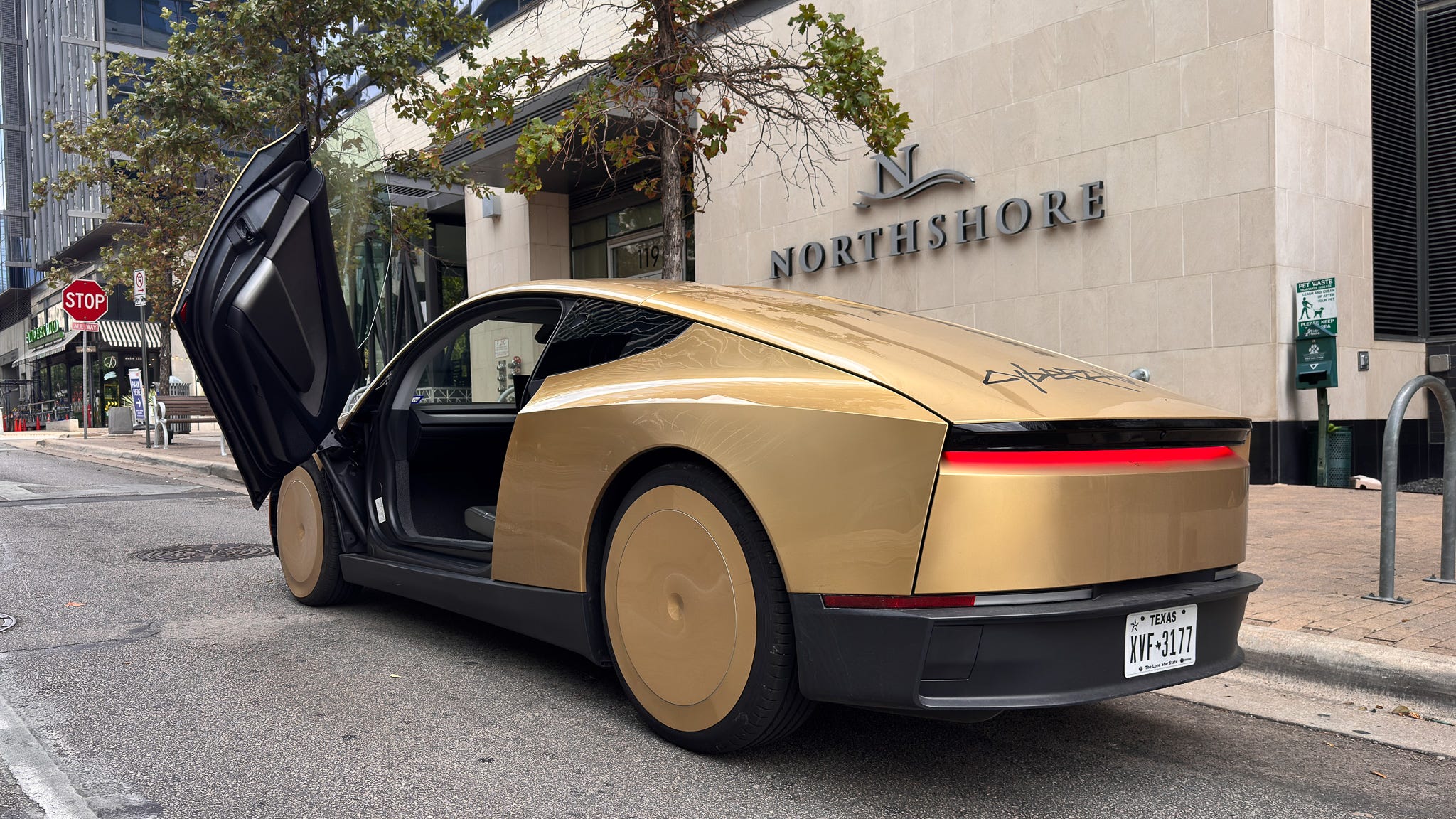
Software-defined vehicles have their benefits, but faulty code is an Achilles heel.
The days of autonomous driving as science fiction are no longer. Robotaxis from Tesla, Waymo, and Zoox have become common fixtures in cities across the U.S. Though these companies are effectively still in a real-world trial stage, regular folks can now take unsupervised autonomous rides with the same ease as summoning an Uber or Lyft.
Tesla is the latest company to roll out a new robotaxi designed for that purpose from the ground up. Our social media editor Jofel Tolosa just attended Tesla’s Cybercab Launch Day in Austin, Texas, and hailed five rides over the weekend to test the autonomous vehicle’s self-driving capability. I happened to be in town for the FIA World Endurance Championship race at Circuit of the Americas, so our head of editorial, Ed Loh, asked me to continue testing the Tesla Cybercab to expand MotorTrend’s experience behind the wheel … erm, screen.
A Successful First Trip
My first ride went well, mimicking Tolosa’s experience in the days prior. Hailing the ride was easy on the app with predicted pickup and drop-off times as well as an estimate for the fare. The Cybercab took 17 minutes to arrive, just as predicted, and pulled up about 150 feet away from my hotel’s door, requiring me to cross the street twice. A light bar illuminated in purple, matching the color shown beneath the way-finding arrow in the Tesla Robotaxi app, letting me know this car was mine. Hilariously, I’m colorblind, so I didn’t think the color was any different from the typical LED white (or white-ish blue) of modern automotive headlights.
Everything went smoothly, at first, from there. When you step up to the car, depending on what side you approach, one of the scissor doors will open, but it will slow down if you get too close so as to not hurt you. The doors close automatically when you buckle your seat belt.

The ride is very similar to a Model 3’s. Overall, it’s quite smooth, but you feel the road’s bigger bumps, especially from the rear suspension. The cabin is extremely quiet. The seats are a cab-grade type of upholstery, very flat and un-bucketed. I wouldn’t expect these to be comfortable on long drives.
There are some creature comforts like USB-C ports under the display and window switches. Amusingly, the windows only roll down far enough to match the width of a few fingers, so there’s no way to hang out of the vehicle while it’s moving. You can also adjust the center armrest to be flush with the seat backs so you can slide through when it’s time to exit.
I felt safe on this first ride of mine. The autonomous experience is just like the regular version of Tesla’s Full-Self Driving (Supervised), or FSD, where you can see the route and decision-making on the screen. The instrument cluster is deemphasized in the top left corner, and the turn signals are displayed on the 3D rendering of the Cybercab in addition to the little window up top. However, there’s no turn signal clicking sound, which I thought was quite eerie.
Drop-off at my selected coffee shop was similar to pickup. The Tesla Cybercab stopped across the street, a ways down from the front door. To exit, there’s a view that pops up on the display showing three camera angles for safety and on-screen buttons to open either of the doors and the trunk. Once you’re out of the car, the door closes automatically.

There’s a post-ride procedure that pops up in the app when you’re out of the car. Tesla thanks you for riding and again allows you to open the doors or trunk using your phone screen. Annoyingly, there’s a cutesy tip screen asking if you want to tip $0.69, $4.20, or Other below the selector that allows you to rate the ride out of five lightning bolts. There’s also a text box so you can leave a message for how Tesla can improve on the Cybercab experience.
The ride was far more expensive per mile than any of Tolosa’s prior trips. I was charged $12.68 for going a whopping 0.8 mile, which comes out to a rate of $15.85 per mile. As we determined in our earlier write-up, that’s far more expensive than the going rate of other ride-hailing services, which charge $1–$2 per mile. Tesla uses dynamic pricing to balance supply and demand, which explains why the charge was so high on the tail of debut weekend.

When Things Go Wrong
My testing took a turn for the worse when it was time to return to the hotel. Once I hailed a second Cybercab, it showed up in exactly the same spot where I was dropped off, across the street and down the road from the coffee shop.
I went to the passenger-side door and it opened automatically, just like the first time. Once I got inside, I saw an “Aw, Snap!” error screen that looked like it was from a Google Chrome browser tab. At the top of the display, there was a warning that said, “Issue identified—resolution in progress.”
I started poking around the touchscreen to see if I could call support or change any settings. It wouldn’t let me do anything, though the window controls still worked. The doors have a physical release, so you can push them open like you would in a McLaren.
I wanted to get back to the hotel for my upcoming flight, so I tried to initiate the ride from my phone app using a similar ride-start screen that showed on the main display during the first stint. Hitting that button started the ride and the car began driving without showing any changes on the screen.
I didn’t feel unsafe before, but I did now. I couldn’t see any of the car’s logic, so I didn’t know what moves it was going to make or what route it was taking. For a few minutes, I thought it was driving me back to my hotel for the first few corners based on my memory of the first ride, but then I realized it was just going around the block.

The Cybercab took me back to the exact same spot where I got picked up. It didn’t give any indication the ride was over; even my app screen was indicating the ride hadn’t begun yet and it was still waiting for me to enter the car. At this point, I had to physically open the door with the handle to get out. I was a little worried it was going to drive away while I was getting out because I couldn’t tell if it was in Park.
Once outside the car, I was able to terminate the ride at no cost and filled out the error report saying the Cybercab was broken. For a few minutes, the Cybercab sat there next to the curb but eventually drove off while I waited for a Lyft to come rescue me. I was charged $10.43 to go 0.86 mile, or a rate of $12.13 per mile. Tipping $2.00 brought the price up to be just shy of the Tesla’s $12.68 fare.

Comparison to Waymo
As I live in Los Angeles, I have ample opportunities to test Waymo’s own robotaxi fleet on the regular. Since riding in the Cybercab on September 7, 2026, I also took a Waymo trip for a night out in L.A. My route saw me travel 12.24 miles from the West Side to Korea Town for a duration of 29 minutes. The trip cost $21.46, just $1.75 per mile.
Tesla’s Cybercabs are not yet able to drive on the freeway, but Waymo’s Jaguar I-Pace robotaxis are now certified for use on the interstate. During my ride, I saw speeds as high as 65 mph and felt safe throughout the journey.
I so far have 31 Waymo rides in the bag over 188 miles and 627 minutes of use, so I’m familiar with the driving behavior of the autonomous I-Paces. The Jaguar rides rougher overall than the Cybercab, but it generally absorbs larger impacts better. Acceleration and turning are snappier as well. The in-car experience is less automated, but you still have access to entertainment apps through your account, just like you do in the Tesla. Waymo’s screens are behind the times, even though its route-mapping and exterior renderings are high quality.

So far, Tesla has a ways to go before it catches up to the overall robotaxi experience of riding with Waymo, but the service is still in its infancy. The latter only just opened to the public on Friday, September 4, 2026. There are 45 Cybercabs operating in the Austin area, according to the Texas Department of Motor Vehicles. Tesla says pricing should come down when more Cybercabs enter the fleet.
Stay Ahead of the Curve.
Get the newest car reviews, hottest auto news, and expert analysis of the latest trends delivered straight to your inbox!
Billy Rehbock’s passion for cars started with his dad’s Volkswagen Jetta GLX, his mom’s Cabriolet, and his own Hot Wheels collection. A USC graduate with a Master of Science in journalism, he’s an associate editor for the MotorTrend Buyer’s Guide and covers everything from sports cars to SUVs.
Read More


