
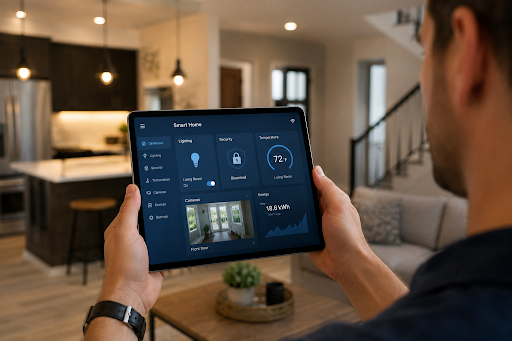
A homeowner in suburban Atlanta closed on a new build last spring. Within six months, she had a smart thermostat from the HVAC contractor who did her tune-up, a leak sensor her insurance agent recommended, a video doorbell she bought herself and a garage door opener the builder threw in at closing.
Four devices, four apps, four service relationships and no communication between any of them. When her water heater failed in October, none of it helped her find a plumber, and none of the professionals who had touched the home since closing knew anything about the others.
YouGov’s 2024 US Smart Home Trend Report found 65% of Americans now own at least one smart home device, up from 51% in 2020. A 2026 synthesis of RubyHome, Mordor Intelligence and Statista data puts roughly 77 million U.S. homes on smart-home devices. Adoption has crossed a threshold. The infrastructure hasn’t.
The house is no longer a static asset that changes hands and disappears until the next transaction. It is a data-producing entity, and whoever holds the connective tissue holds the customer.
The post-close vacuum
Mortgage and title have spent years perfecting the closing. The moment the deed records, most of the relationship goes dark. The homeowner becomes a servicing statement, a tax escrow, an annual renewal.
Meanwhile, she has ten or fifteen touchpoints a year with contractors who now know more about the physical state of the home than the lender who financed it. A 2024 Nationwide survey found 34% of homeowners own smart video doorbells and 32% have smart security cameras, all generating continuous usage and incident data. Almost none of it flows back to the professionals who orchestrated the purchase.
What connected data means at the property level
For a homeowner, connected data is the ability of the people who touch her house to know what happened before they arrived and what needs to happen after they leave. The trades are fragmented, and the incentives to share are weak, but the operators getting it right share three habits:
- They capture structured records at every visit, not just invoices. Photos, part numbers, meter readings, equipment ages.
- They use customer history the way a doctor uses a chart. Each visit builds on the last.
- They connect operational data to at least one adjacent system: accounting, marketing, insurance documentation or a homeowner-facing app.
Based on Field Promax usage patterns, operators who connect their field service data to other tools see compounding gains, while those who keep the platform siloed plateau within the first year.
Where servicing and the trades are already colliding
Servicers have noticed. Sagent’s Dara platform, described in HousingWire’s coverage as unifying data across the servicing lifecycle, starts from the premise that the homeowner deserves a single view of the property.

On the trades side, the same movement is happening one vertical at a time: HVAC platforms integrate with rebate programs, plumbers push equipment data into insurance workflows, property managers tie maintenance records to tenant portals. The pieces exist. The seams don’t.

Insurance agents in the Nationwide study most often recommend smoke and carbon monoxide sensors (56%), smart locks (54%) and leak-prevention devices (54%). If the plumber installing that sensor captures the date, model and location, and it reaches the carrier, the premium reflects reality within days instead of at renewal. Nobody in that chain has a reason to build the integration, which is why it mostly doesn’t exist.

The trust problem the industry keeps avoiding
Consent is getting harder to earn. YouGov found data privacy is the biggest barrier to adoption, with 50% of Americans over 45 concerned against 39% under 45.
The Association for Smarter Homes & Buildings (ASHB) 2024 survey holds a point that belongs on every mortgage and title desk: Asked which companies they are most comfortable sharing data with, homeowners rated smart HVAC and air-quality companies above general contractors, electricians and plumbers.
Trust tracks how transparent the operator is, not license status or years in business. Anyone assuming they inherit it because they closed the deal is miscalculating.
What operators are doing differently
Phone-heavy verticals are digitizing intake first. About half of inbound leads still arrive by phone, which is why call-to-job-card conversion speed inside the dispatcher view matters more than lead-form workflows. For anyone referring homeowners to trades, the fastest-responding operator wins the job.
Documentation is a competitive weapon. Across the contractors using our platform, arborists pricing tree removal see fewer scope disputes when estimates carry itemized lines and photos rather than a lump sum. The same holds for any post-close service a homeowner may later question: photo-backed records leave a trail title companies, insurers and future buyers can use.
Payment speed is a service quality signal. The typical drywall contractor on our platform spends more time chasing payment than chasing work, and shops using in-app payment links collect 15-30% faster than those emailing PDFs. Homeowners who pay in ninety seconds form a different idea of good service, and it ports straight to their servicer and title company.

What this means for real estate, mortgage and title
The referral relationships that matter most are with trades that document well. An agent who sends a buyer to a shop with structured records and warranty tracking is protecting a future title chain and a future insurance claim.

Servicers will be asked to consume trades data whether they plan for it or not. ResearchAndMarkets forecasts North American smart homes reaching 83.8 million by 2028, generating maintenance logs, sensor alerts and warranty events. Those who build the pipes will price risk better. Those who don’t keep flying blind between escrow analyses.
Retention will be won on ambient value. Nationwide found 60% of smart device owners feel safer and 44% say the products ease their worries. The servicer or agent who plugs into that layer becomes a partner instead of a bill.
An operator takeaway
Every technician visit, sensor reading, warranty claim and payment is a data point someone in the housing ecosystem could put to work. Most are not. Whoever connects that stream, ethically and with the homeowner’s consent, owns the next generation of the relationship.
Bhargavi Halthore is a content writer at Field Promax.
This column does not necessarily reflect the opinion of HousingWire’s editorial department and its owners. To contact the editor responsible for this piece: [email protected].


