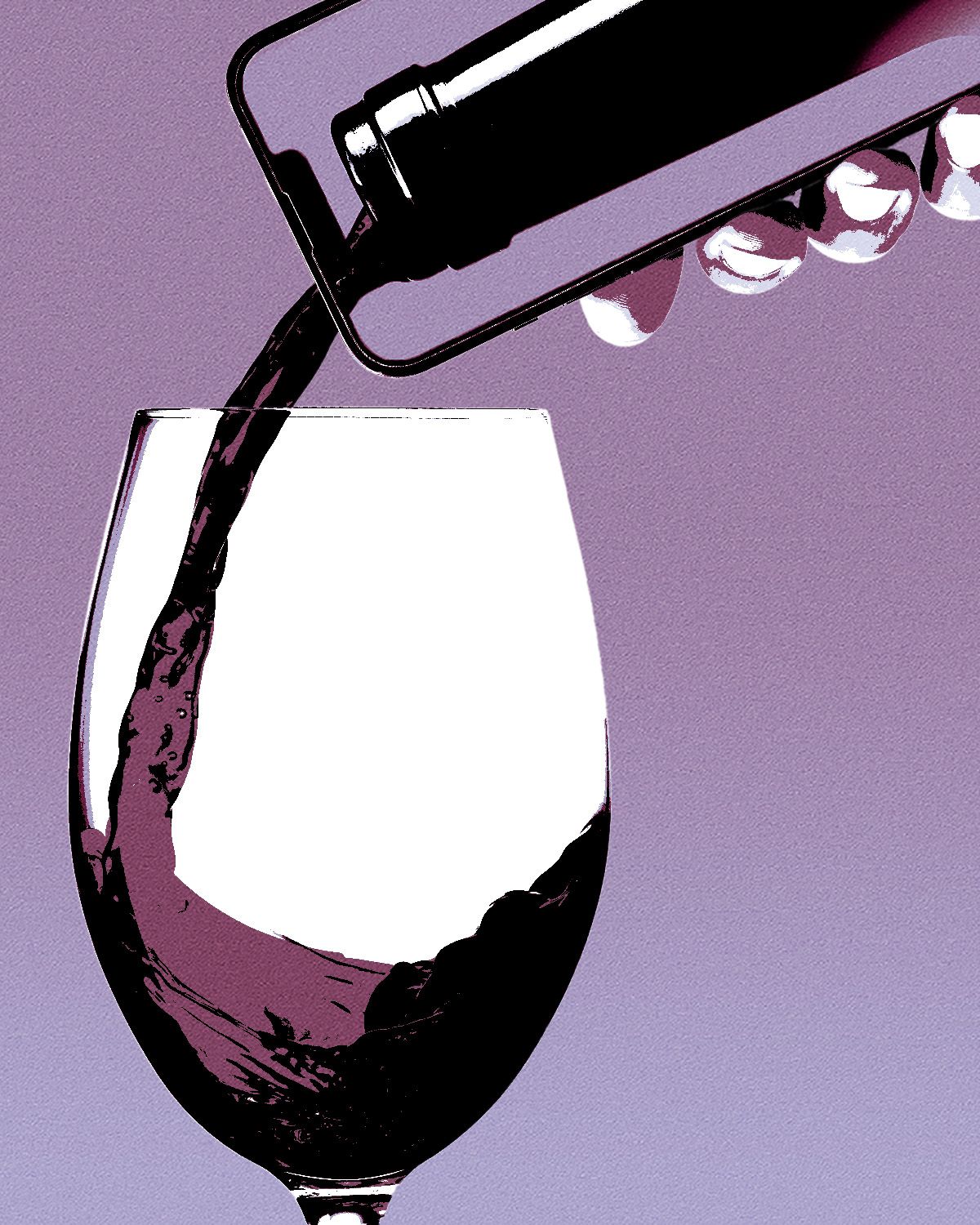
If you’re looking for something new to argue about at the dinner table, might we suggest AI?
Chances are, you won’t have to search very far for source material. As the popularity of tools like ChatGPT and Gemini grows—the former surpassed TIkTok to become the most downloaded free app of 2025—so do the number of people taking them to restaurants. Many use AI to choose their wine, even if a sommelier is standing right there.
“Once I started seeing it, I never stopped seeing it,” says Christian Urbina, the head sommelier at The Dabney in Washington, DC. “It’s not only younger guests, it’s everyone. You can immediately tell when people are sitting at a table typing into ChatGPT.”
Depending on who you ask, deploying AI to pick out wine either makes perfect sense or none at all. Adherents say these platforms remove social friction and help democratize wine. Others argue that AI tools are instruments of social isolation that prevent people from living in the moment or learning how to identify wines they’ll enjoy in the long run.
It’s a complicated question with notes of existential dread: Why do people outsource their drink order to something that definitionally can’t taste?
June Rodil is unbothered. The CEO and partner of Houston’s Goodnight Hospitality sees AI apps as a confidence-booster for guests. “When people pull out ChatGPT or Claude, a lot of times it has to do with things they’re embarrassed to talk about—they don’t want to ask about the price or how to pronounce something in front of the table,” she says. “But they have to order from you. We’re still going to engage somehow.”
Besides, the cork is out of the bottle, so restaurant professionals might as well find ways to embrace AI models, Rodil says. She enlists one for back-of-house endeavors like grammatically proofing wine lists that span multiple languages and classification systems.
“I never want to be the grandma who can’t work the VCR,” she says. “If you don’t give [new technologies] a try, you’re going to lose an audience, and restaurants are for everyone.”

Illustration Leurin Estévez. Images via Getty.
Some wine professionals are less sanguine. In an Instagram Reel that drew heavy engagement, New York City sommelier Elizabeth Roberts describes the “crushing” experience of “standing in front of a table trying to help you, but instead you’re asking the little robot in your phone.”
Maybe you don’t care if you hurt your sommelier’s feelings. But there are still all sorts of offline implications to ditching interpersonal interactions in favor of platforms prone to cognitive biases.
On a strictly economic front, it weakens the value proposition of dining out. “If you’re in a place where the wine list is extensive, and there’s a sommelier, that’s part of what you’re paying for,” says Urbina. “It’s included in the price.”
Talking about wine with an expert who hasn’t been trained on your speech and thought patterns is an investment that pays dividends too. The practice not only helps you develop your own sense of taste, but can also make it easier to find glasses and bottles you’ll enjoy in the future.
If you think about wine as another language, enlisting AI to decide what to order—quick, before the somm comes over!—is like cramming for an exam that no one is making you take. But what if you try having a conversation with a native speaker? As anyone who’s ever shopped in a Parisian market using their middle school French can attest, you tend to acquire a lot more fluency from those real-time exchanges, even (or especially) if they’re clumsy.
Good hospitality professionals aren’t judging you, either. “There’s nothing wrong with not knowing anything about wine or not knowing what to order,” says Annie Shi, the co-owner and beverage director of King and Jupiter, and owner of Lei in New York City. “That’s literally what the staff is there for.”
Unlike any AI app, a qualified somm has tasted each bottle on their list and can guide you through its nuances. For instance, maybe you’re eyeing a Georgian Saperavi to pair with your roast lamb. An AI tool can inform you that Saperavi is a tannic red. But the somm can explain why that particular, qvevri-aged bottle is softer and rounder than others.
Gradually, and then suddenly, you’ve learned about the grape variety, Georgia’s winemaking heritage, and how tannins interact with food—all without even realizing you needed to ask.
“That’s the whole point of all of this,” says Chasity Cooper, author of The Wine Conversation Generator. “It’s so important to put our phones down and actually connect with each other and learn from one another.”
After all, we could all stay at home and drink wine by the blue light of our phones. One reason we put on hard pants (MAYBE) and brave the world outside is to soak up the intangible magic of restaurants. When we give AI the night off, we get to have the sorts of experiences that no algorithm can predict. The robots in our phones could never.