Digital Trends may earn a commission when you buy through links on our site. Why trust us?
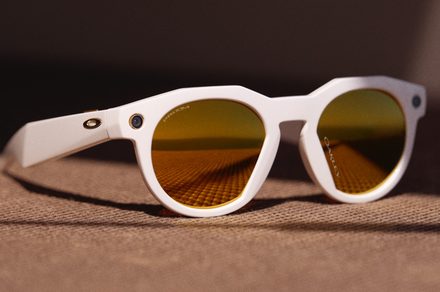
Codenamed Scriber and Blazer and already through FCC filings, Meta’s prescription-focused AI glasses are shaping up to be the company’s most inclusive wearable launch yet.

Meta
For the billions of people who rely on corrective glasses every day (including me), smart glasses have always been a slightly awkward conversation. Sure, you can already pick up Ray-Ban Meta frames with your prescription built in, but it looks like Meta has something better in store for us.
According to a Bloomberg report, Meta is working on two new AI glasses designed specifically for prescription wearers rather than treating them as an add-on afterthought. The models could arrive in rectangular and rounded frame styles. Unlike current offerings, they will be sold through conventional prescription eyewear retailers.

Will the new prescription-friendly glasses look any different?
This could be the first time the Meta and Ray-Ban collaboration has directly aimed its vision-corrected crown at the primary audience. However, that is the extent of the information the outlet provides. There’s no word on how the frames might differ physically from the current models.
However, if I were to speculate, it could have something to do with the lens housing, thickness, and the weight of the glasses.
Beyond the hardware, I feel, what would truly make the purported AI glasses prescription-friendly is the ability to talk to any neighbourhood optician and have them work on it. That kind of accessibility could really make the glasses prescription-friendly.

What else do we know about Meta’s upcoming smart glasses?
The Verge separately flagged FCC listings for the purported glasses internally codenamed “Scriber” and “Blazer.” Both are listed as production units, which typically signals a launch isn’t quite far off. A detail that stands out is that Blazer might come in a larger size than Scriber.
Both models should also support Wi-Fi 6 UNII-4 band, something that the current Ray-Ban smart glasses lack. It would open the door to faster data transfer, and perhaps to livestreaming. Anyways, no display is expected on either model.
What’s clear, however, is that Meta is eyeing prescription wearers as the biggest untapped market for its smart glasses.

For more than five years, Shikhar has consistently simplified developments in the field of consumer tech and presented them…
Research finds generative AI making frauds a cakewalk for bad actors
New research shows scams that once took hours now take minutes.

Generative AI isn’t just changing how we work, but it’s also transforming how scams are pulled off. As per Vyntra’s 2026 report, tasks that once took fraudsters over 16 hours can now be done in under 5 minutes using generative AI tools.
That’s a massive shift. What used to require skill, time, and effort can now be automated and scaled almost instantly, turning fraud into what experts are calling a $400 billion global industry.
Study says AI chatbots are increasingly ignoring humans, but it isn’t quite Skynet yet

Isn’t it frustrating when you ask an AI chatbot something, and halfway through, it just goes off track? You might be discussing a simple technical fix, and suddenly it throws in random suggestions — things that don’t even exist or don’t make any sense. It’s confusing, and honestly, pretty annoying.
What makes it worse is that it often feels like the chatbot isn’t even paying attention to what you said. You give it clear details, but it either ignores them or responds with something completely unrelated. That’s exactly what this study points out. AI isn’t as reliable or “obedient” as we thought, and if you’ve used one for long enough, you’ve probably noticed it yourself.
I see Apple skipping the AI hellfire, but shaping Siri as the most flexible assistant

When Apple introduced Siri back in 2011, the world freaked out. A personal assistant on a phone with conversational chops elicited an audible gasp from the audience, and plenty of fear. “That it’s a sinister, potentially alien artificial intelligence that’s bound to kill us all,” CNN’s coverage surmised. It was a one-of-a-kind advancement, something Apple was delivering consistently back then.
And then it fell off. Now, Siri has a reputation for being, well… not exactly the sharpest voice assistant, especially in a pool of next-gen generative AI assistants such as Claude, Gemini, and ChatGPT. Anyone who’s tried asking it a tricky question knows exactly what I mean — it’s a drag to talk with Siri, and more importantly, get work done. But things are starting to shake up. Bloomberg’s Mark Gurman, a prolific all-things-Apple eavesdropper, shared yesterday that Siri might soon open its doors to third-party AI tools in a major iOS update. That’s right! Apple’s walled garden could finally be cracking.