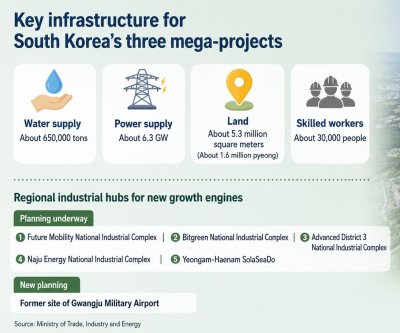
A graphic outlines key infrastructure needs and planned regional industrial hubs for South Korea’s three mega-projects. The image shows the former Gwangju Military Airport site, selected as a candidate location for a semiconductor cluster in southwestern South Korea. Data by Ministry of Trade, Industry and Energy, Gwangju City. Graphic by Asia Today and translated by UPI
July 7 (Asia Today) — South Korea’s proposed RE100 industrial complex has yet to pass a special bill or select a site more than a year after the Lee Jae Myung administration introduced it as a flagship industrial policy.
The delay contrasts with the government’s new 800 trillion won, or about $525 billion, southwestern semiconductor mega-project, which is moving quickly enough to force revisions to national power and industrial water plans.
Industry officials and experts say large-scale industrial complexes require verified corporate investment demand and realistic infrastructure plans for electricity, water and transmission networks. They say the government’s mega-project blueprint may be moving ahead before those conditions are fully tested.
According to the Ministry of Trade, Industry and Energy, the special bill for the RE100 industrial complex remains pending before a subcommittee of the National Assembly’s Trade, Industry, Energy, SMEs and Startups Committee.
Because the bill has not passed, follow-up steps have not begun, including a pilot site competition, candidate site selection and project operator designation.
“The passage of the law determines the entire schedule,” a ministry official said. “Under the procedures set by the law, a committee would be formed, pilot complexes would be designated and operators would be selected.”
“It is difficult to move forward with practical industrial complex plans before the special bill is passed,” the official said.
The pending bill is the official reason for the delay, but industry officials say attracting companies could also be difficult. The government has recently sounded out major companies about moving into the proposed complex, but the response has reportedly been less active than expected.
Many companies are already pursuing renewable-energy power purchase agreements and their own renewable-energy procurement plans, reducing incentives to change existing investment strategies to match the government project.

Yoo Seung-hoon, a professor in the Department of Future Energy Convergence at Seoul National University of Science and Technology, said the RE100 industrial complex has a sound policy purpose but faces practical limits.
“The policy goal is good, but there are idealistic aspects in reality,” Yoo said. “The industry ministry is pushing the project, but the agencies overseeing renewable-energy supply and the power grid are separate, creating structural limits.”
Yoo said the mega-project could have a more realistic effect on regional economies.
The government is taking a different approach to the southwestern semiconductor cluster and AI data center plan announced last month during a national briefing on three mega-projects.
The Ministry of Climate, Energy and Environment is effectively rewriting the 12th Basic Plan for Long-Term Electricity Supply and Demand to reflect new power demand from the mega-project. A working draft originally expected last month has been delayed by several months.
The ministry is recalculating power demand from the semiconductor cluster and AI data centers and reviewing the generation mix, transmission grid and system operation plans.
Experts say large industrial complexes usually require the government to first verify corporate investment demand and infrastructure feasibility. Companies must confirm the scale and timing of investment before officials can calculate electricity and water demand. Those estimates are then used to prepare power generation, transmission and industrial water supply plans.

Analysts say the RE100 industrial complex has struggled for more than a year because it has been difficult to secure both corporate demand and policy feasibility.
The different pace has also fueled political criticism that the mega-project was hastily prepared. The government has presented an 800 trillion won investment blueprint, but participating companies have made their investment plans conditional on the availability of infrastructure, incentives and other operating conditions.
Industry officials say whether the government can turn the blueprint into actual investment will depend less on the announcement itself and more on follow-up infrastructure and corporate execution.
“There is nothing wrong with the government moving quickly,” one industry official said. “But the success of the mega-project will depend on how realistically it can secure the basic conditions companies need to invest, including power, water and transmission networks.”
— Reported by Asia Today; translated by UPI
© Asia Today. Unauthorized reproduction or redistribution prohibited.
Original Korean report: https://www.asiatoday.co.kr/kn/view.php?key=20260707010002657