In a new weekly update for pv magazine, Solcast, a DNV company, reports that Western Europe saw its strongest summer solar resource since at least 2007 in 2026, with GHI 6.9% above average and England and Wales nearly 16% above average. Persistent heat domes brought clear, hot, and exceptionally dry conditions, with temperatures over 2 C above average and severe rainfall deficits, particularly in July.
Western Europe recorded its strongest summer solar resource since at least 2007 during June to August 2026, according to analysis using the Solcast API. Across Europe, global horizontal irradiance (GHI) averaged 3.4% above the 2007-2025 average, with 81% of the area recording above-average irradiance. The repeated formation of heat domes over the season meant multiple long periods of clear skies and hot weather as cloud formation was suppressed. The strongest irradiance gains were concentrated over England and Wales. Above-average conditions extended across much of western and central Europe, but the increases were generally smaller than those recorded across the UK.
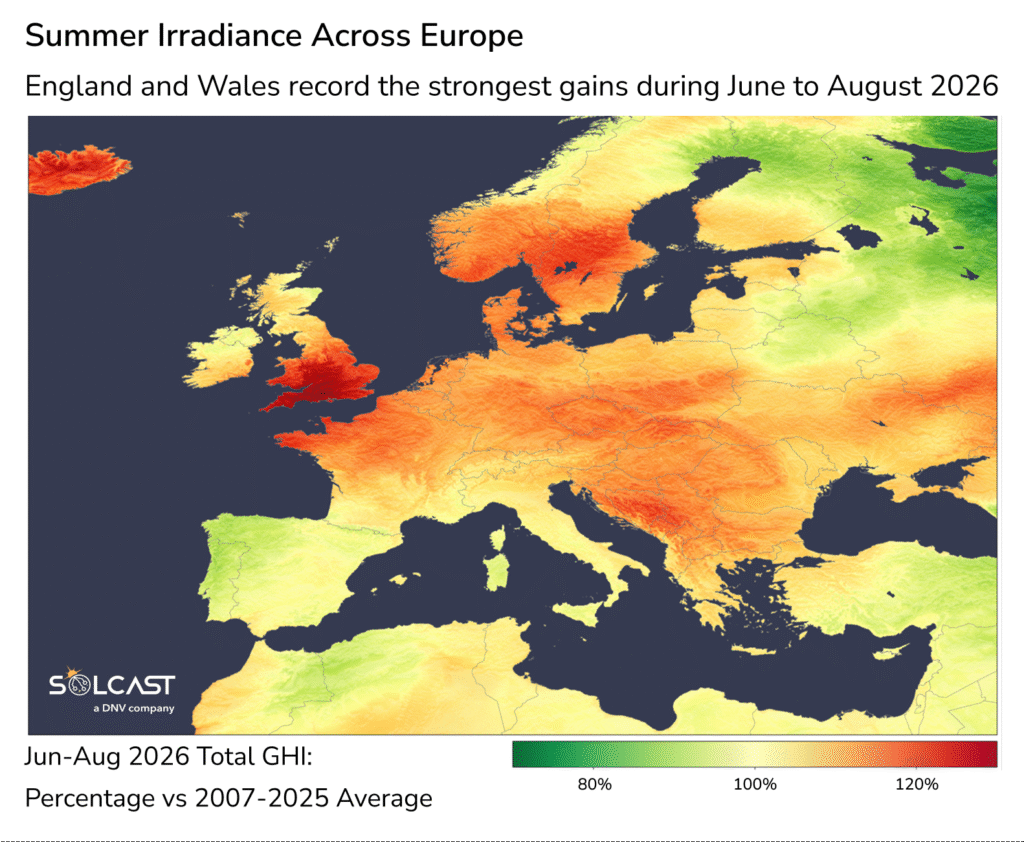
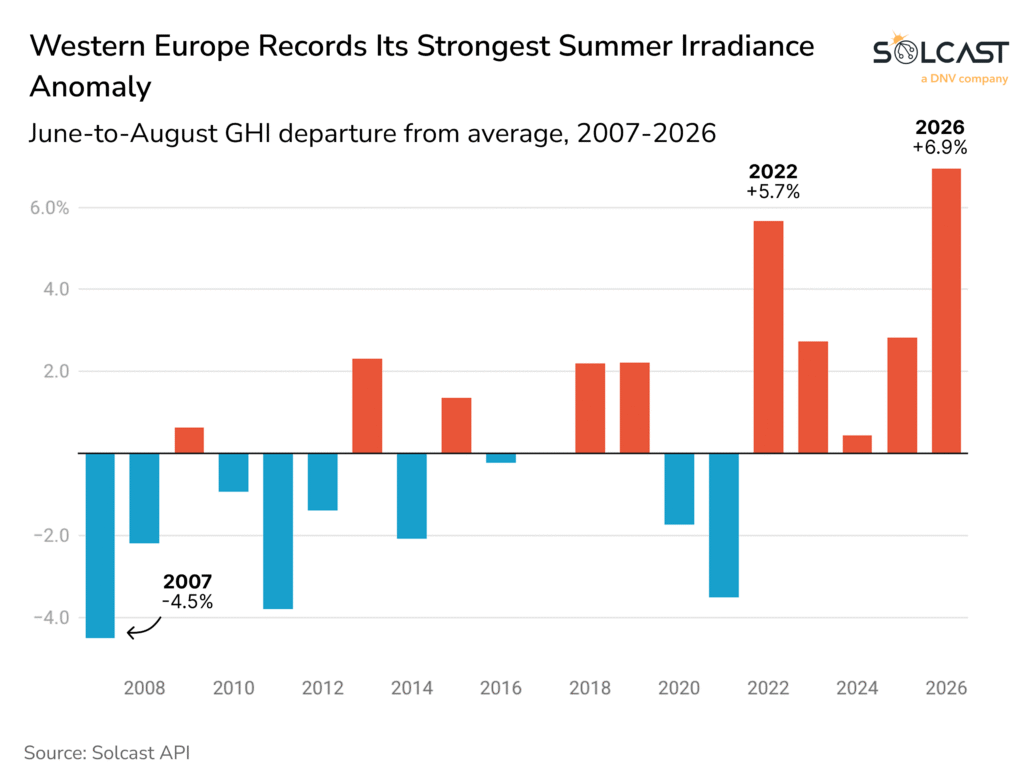
England and Wales recorded GHI nearly 16% above the 2007-2025 average, the largest increase identified in the analysis, while GHI around Paris was approximately 15% above average. The regional increase also stands out over time. Summer GHI across western Europe was 6.9% above the 2007–2025 average in 2026, exceeding the previous high recorded in 2022.
The elevated irradiance coincided with an exceptionally warm and dry summer across western Europe. ERA5 data shows that rainfall was 18% below average in June and 70% below average in July. Rainfall increased in August but remained 17% below average. Temperatures across the same area
were more than 2 C above average in all three summer months.
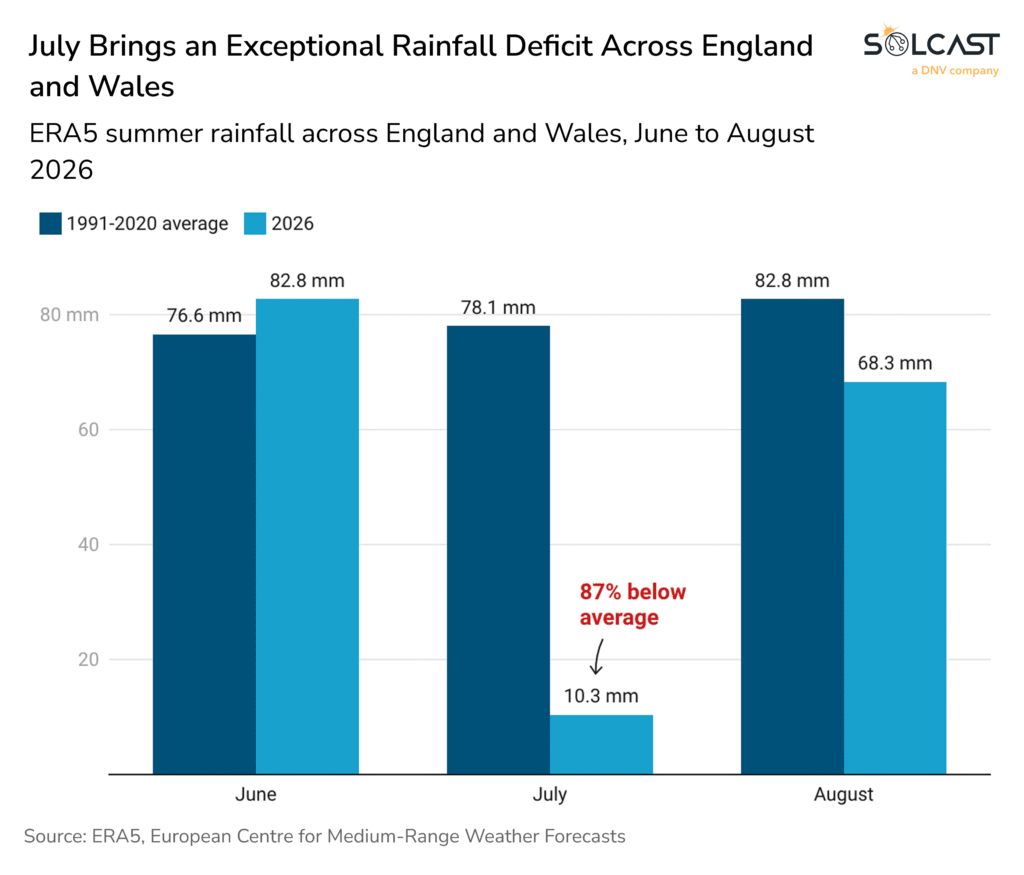
July marked the driest part of the season. England and Wales experienced their driest July on record, while the European Commission’s Joint Research Centre reported widespread drought conditions across Europe in its July 2026 drought assessment. ERA5 data for England and Wales shows the scale of the July rainfall deficit, with just 10.3 mm recorded compared with a 78.1 mm average.

The elevated irradiance coincided with an exceptionally warm and dry summer across western Europe. ERA5 data shows that rainfall was 18% below average in June and 70% below average in July. Rainfall increased in August but remained 17% below average. Temperatures across the same area
were more than 2°C above average in all three summer months.

July marked the driest part of the season. England and Wales experienced their driest July on record, while the European Commission’s Joint Research Centre reported widespread drought conditions across Europe in its July 2026 drought assessment. ERA5 data for England and Wales shows the scale of the July rainfall deficit, with just 10.3 mm recorded compared with a 78.1 mm average.
Solcast produces these figures by tracking clouds and aerosols at 1-2km resolution globally, using satellite data and proprietary AI/ML algorithms. This data is used to drive irradiance models, enabling Solcast to calculate irradiance at high resolution, with typical bias of less than 2%, and also cloud-tracking forecasts. This data is used by more than 350 companies managing over 350 GW of solar assets globally.

The views and opinions expressed in this article are the author’s own, and do not necessarily reflect those held by pv magazine.

This content is protected by copyright and may not be reused. If you want to cooperate with us and would like to reuse some of our content, please contact: [email protected].