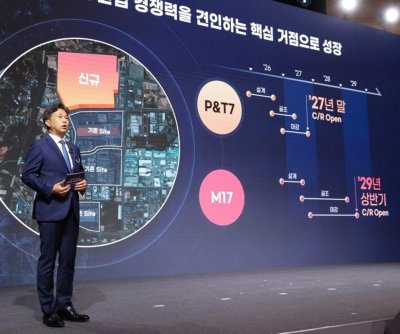
SK hynix CEO Kwak Noh-jung speaks during a meeting in Asan, South Chungcheong Province, South Korea, 02 July 2026, to unveil investment plans for the region as part of a government initiative to advance technologies and establish South Korea as an industrial powerhouse in the AI era. Photo by YONHAP / EPA
July 7 (Asia Today) — SK hynix’s planned U.S. American Depositary Receipt offering is drawing strong interest from global institutional investors, raising expectations that the chipmaker’s valuation could be reassessed in global markets.
The listing is seen as a positive step for SK hynix because it would allow the company to secure capital and gain broader recognition for its growth prospects in artificial intelligence memory. At the same time, concerns are rising over dilution for existing shareholders and the potential impact on South Korea’s domestic capital market.
Industry officials said Tuesday that SK hynix’s planned Nasdaq ADR listing is being viewed in two ways: as an opportunity to reduce the Korea discount and revalue the company or as a source of concern because of shareholder dilution.
The offering will be conducted through the issuance of new shares. SK hynix plans to issue 17.79 million new shares, equal to about 2.5% of its stock.
That means existing shareholders’ ownership stakes will decline. The increase in the number of outstanding shares could also dilute per-share value. Market watchers said the large new share issuance could put short-term pressure on the stock, even as investors remain positive about SK hynix’s AI memory competitiveness and future investment plans.
Still, industry observers said the strong buying interest from global institutional investors, even after recent corrections in memory chip stocks, reflects confidence that demand for high-bandwidth memory will continue to grow. That demand is being driven by investment in AI data centers as well as the spread of generative AI, AI agents and physical AI.
Analysts also say the dilution burden could be offset over the long term if the funds raised through the offering lead to expanded AI memory production capacity and improved profitability.

SK Group Chairman Chey Tae-won has said the group plans to double wafer production capacity within five years. Proceeds from the ADR offering are expected to support that expansion strategy.
SK hynix plans to use most of the funds raised through the offering to expand domestic production facilities. The company plans to invest in the first fabrication plant at the Yongin Semiconductor Cluster, build an advanced packaging facility in Cheongju and purchase cutting-edge equipment, including extreme ultraviolet lithography machines.
SK hynix also plans to build semiconductor clusters in other regions, requiring large-scale investment.
The offering also poses a new challenge for South Korea’s capital market. If one of the country’s leading technology companies raises tens of trillions of won in the U.S. market, it could underscore concerns that the Korean stock market has relatively weaker capacity to attract large-scale investment.
The structure could allow global investors to invest in a leading Korean semiconductor company through U.S. ADRs rather than the Korean stock market.
If the ADRs receive a higher valuation than SK hynix’s domestic shares, it could strengthen the trend of foreign investors using U.S. markets to access major Korean companies. That could again highlight the Korea discount, the long-running undervaluation of Korean equities.
As semiconductor companies continue massive investment amid intensifying AI memory competition, the market in which companies raise capital could affect not only corporate competitiveness but also the competitiveness of national capital markets.
Some analysts, however, say direct inflows from the deep U.S. capital market could help ease the Korea discount. With SK hynix’s market value surpassing $1 trillion and global investors focusing on the company, demand for Korean equities could expand further.
— Reported by Asia Today; translated by UPI
© Asia Today. Unauthorized reproduction or redistribution prohibited.
Original Korean report: https://www.asiatoday.co.kr/kn/view.php?key=20260707010002529